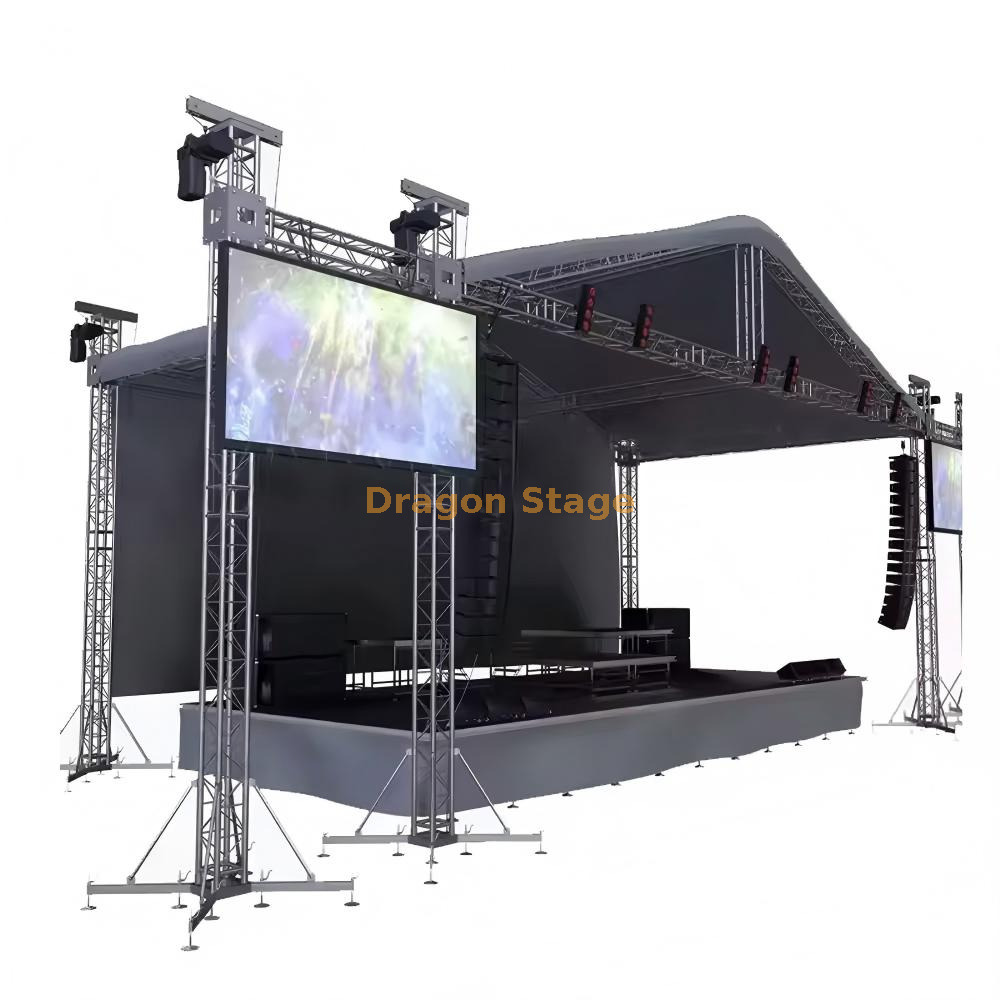
Planning a modular stage system for outdoor festivals is not only about building a platform and putting performers on it.
A concert stage is actually the focal point where performers interact with the audience.
If the stage design is not properly planned, even a good performance can feel weak.
In real projects, stage planning usually involves several practical considerations:
the event environment
audience size and viewing angle
stage dimensions
truss roof and equipment loads
wind and structural safety
A well-planned modular stage system helps organizers install faster, keep the structure stable, and adapt the stage to different festival environments.
Why Modular Stage Systems Are Ideal for Outdoor Festivals
Outdoor festivals rarely take place in identical venues.
Sometimes the event is in a park, sometimes on grass fields, sometimes in open squares.
Because of this, modular stage systems are commonly used in festival production.
Flexibility for Different Event Sizes
A modular stage can easily expand or reduce its size depending on the event scale.
For example:
The same modular decks can be rearranged to create different stage sizes.
In practice this saves a lot of time.
Event companies do not need to redesign a stage for every project.
Modular stage decks and truss systems are designed for quick installation.
Normally they use standard deck sizes and interlocking connections.
Because of this:
installation time is shorter
fewer workers are required
transportation becomes easier
For touring events or rental companies, this efficiency is very important.
Compatibility with Lighting and Truss Systems
A concert stage is not only a platform.
It must support lighting systems, LED screens, sound systems, and sometimes special effects equipment.
Modular stage systems are usually designed together with truss structures, which allow technicians to hang lighting fixtures and other equipment in proper positions.
This combination makes the stage not only functional, but also visually effective during the show.
Step 1 – Evaluate the Event Environment
Before deciding stage size or equipment layout, the first step is always understanding the event site.
Different ground conditions and environments require different preparation methods.
Ground Surface and Load Bearing Capacity
The ground condition affects how the stage should be installed.
| Ground Type | Preparation Method |
|---|
| Grass | Steel base plates |
| Asphalt | Rubber protection plates |
| Concrete | Direct installation |
| Sand | Load distribution panels |
If the ground is soft, load distribution becomes especially important to avoid uneven settlement.
Weather Exposure and Climate Conditions
Outdoor stages must consider weather conditions.
Typical risks include:
For this reason, many festival stages include a roof system or canopy to protect performers and equipment.
Wind exposure also needs attention, especially when large LED screens are installed.
Event Site Layout Planning
A stage is only one part of the whole event site.
When planning a stage layout, it is also necessary to think about:
backstage working area
control booth for lighting and sound engineers
audience entrances and exits
emergency evacuation routes
Good layout planning helps avoid crowd congestion and improves event safety.
Step 2 – Determine Stage Size Based on Audience Capacity
Stage size should not be chosen randomly.
It must match the audience scale and the event environment.
Crowd Density and Space Calculation
Different events have different crowd density levels.
| Crowd Density | Area Per Person |
|---|
| Comfortable | 1 m² |
| Normal Festival | 0.5–0.7 m² |
| High Density | 0.3–0.4 m² |
This calculation helps estimate how large the audience area should be.
Recommended Stage Sizes for Festivals
Based on practical experience, the following stage sizes are commonly used.
| Event Size | Typical Stage Size |
|---|
| Small Event | 6m × 4m |
| Medium Festival | 8m × 6m |
| Large Festival | 12m × 10m |
A wider stage often improves interaction between performers and the audience.
When performers can move more freely across the stage, the show feels more dynamic.
Choosing the Correct Stage Height
Stage height affects audience visibility.
If the stage is too low, people at the back may not see clearly.
If it is too high, the distance between performer and audience becomes less engaging.
Typical festival stage heights range between:
0.6 m – 1.2 m
Larger concerts sometimes use heights up to 2 meters to improve visibility for large crowds.
Step 3 – Consider Audience Visibility and Viewing Angles
One mistake sometimes seen in event planning is focusing only on the stage structure but forgetting the audience view.
In a live concert, audience visibility is very important.
Even if the stage decoration looks impressive, if people cannot see the performers clearly, the overall experience becomes weaker.
So when designing a stage, consider:
where the audience will stand or sit
how far they are from the stage
whether lighting towers or LED screens block the view
A good stage layout allows most audience members to see the performance comfortably.
For many outdoor festivals, a roof system is installed above the stage.
The truss roof has several functions.
Purpose of a Truss Roof in Outdoor Events
The roof structure helps to:
support lighting equipment
hang speakers and LED screens
provide rain protection
create visual stage design
Without a proper roof system, lighting and sound equipment cannot be safely installed.
Common Roof Structures Used in Festivals
Several roof types are commonly used.
Goalpost truss roof
Simple structure, suitable for small stages.
Box truss roof
Higher load capacity, common in medium and large festivals.
Arc roof system
Curved design, often used when visual appearance is important.
Layher roof structure
Highly modular system suitable for complex stage designs.
Load Considerations for Lighting and LED Screens
When designing the roof structure, equipment weight must be considered.
For example:
Engineers normally include a safety margin (around 20%) when calculating loads.
This prevents structural stress during the event.
Step 5 – Stage Lighting Planning
Lighting plays a major role in the visual impact of a concert stage.
But lighting design should balance creativity with technical limitations.
Many designers focus only on artistic effect.
In practice, lighting planning must consider:
truss load capacity
power distribution
installation position
safety clearance
Modern concerts use various lighting technologies:
Among them, spotlights are especially important because they guide audience attention to performers.
When lighting is well organized, it can create a completely different atmosphere for the performance.
Step 6 – Wind Load and Structural Safety
Wind is one of the biggest risks for outdoor stage structures.
Strong wind can cause:
roof uplift
LED screen instability
truss sway
Because of this, structural safety must be evaluated before installation.
Basic Wind Load Engineering Concept
A simplified wind pressure estimation formula is:
Wind Pressure ≈ 0.613 × V²
Where V is wind speed in meters per second.
This calculation helps estimate how much force the structure may experience.
Ballast and Anchoring Solutions
To improve stability, stage structures usually use ballast or anchors.
| Method | Application |
|---|
| Concrete ballast | Large festivals |
| Water ballast | Temporary events |
| Ground anchors | Soil ground |
| Steel plates | Urban pavement |
Correct anchoring significantly improves safety.
Step 7 – Recommended Modular Stage Layout
A typical modular stage includes several components.
Core Components
modular stage decks
adjustable stage legs
guardrails
access stairs
stage skirting
These elements together form a stable stage platform.
Typical Truss Configuration
Most festival stages use a truss layout that includes:
This configuration balances load distribution and lighting design flexibility.
Common Mistakes When Planning Festival Stages
From practical experience, several mistakes appear frequently.
Underestimating Wind Load
Ignoring wind conditions can lead to structural risks.
Wind calculation and anchoring are essential.
Stage Size Too Small
A small stage limits performer movement and reduces interaction with the audience.
Choosing proper stage size improves the performance experience.
Ignoring Equipment Weight
Lighting and LED screens can add significant load.
If truss capacity is not checked carefully, structural stress may occur.
Conclusion
Designing a concert stage is not just about building a platform.
A successful stage system requires coordination between:
environment conditions
audience viewing angles
stage size and height
lighting systems
truss structure loads
wind safety
When these factors are considered together, a modular stage system can create a safe and effective environment for performers and audiences.
For large outdoor festivals, this kind of planning is essential to ensure both performance quality and event safety.