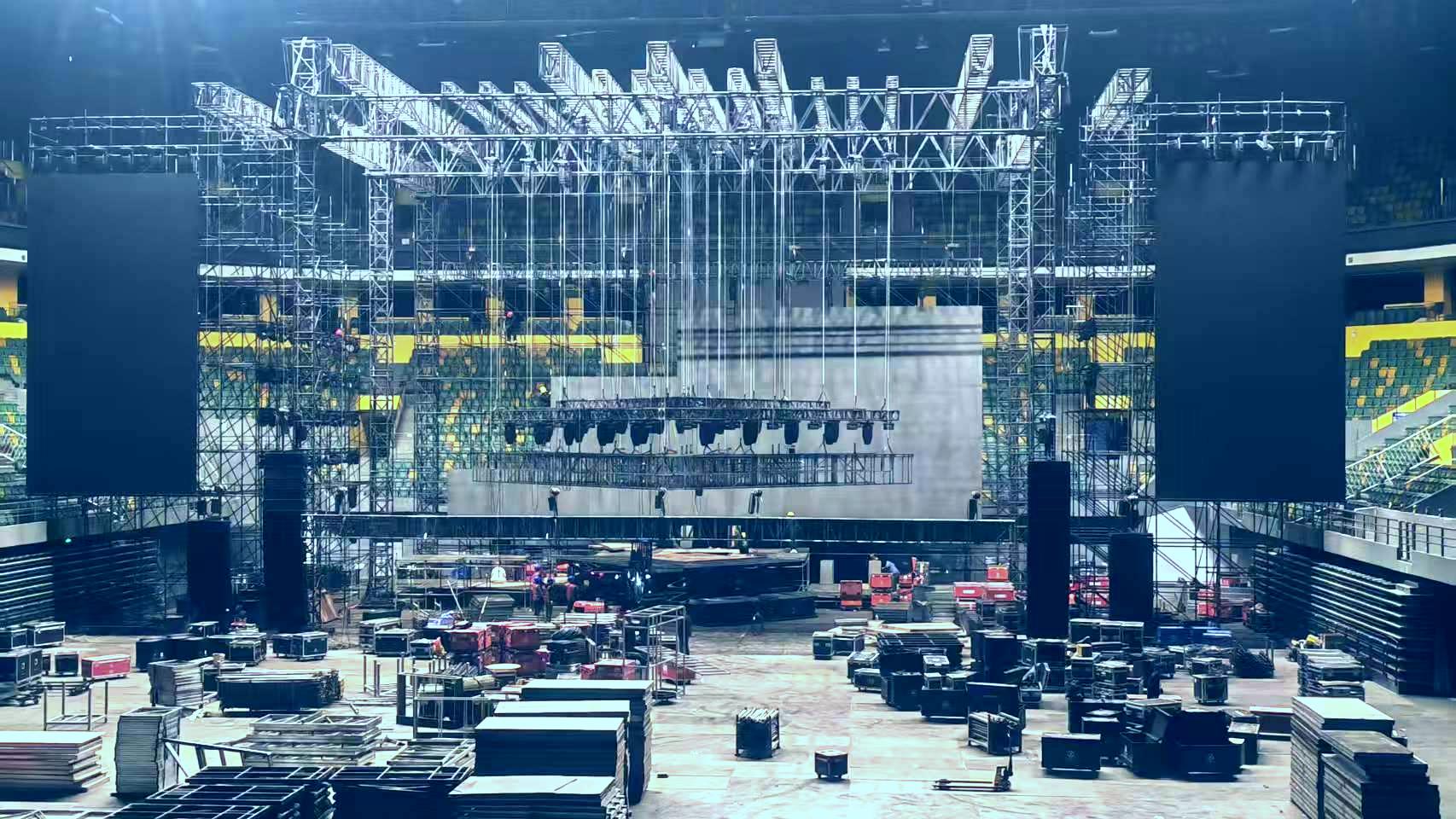
Event organizers often search for solutions to the following problems:
How to build a stage for an outdoor concert?
To build a stage for an outdoor concert, it is recommended to use a modular stage and truss system instead of constructing from raw materials. A typical outdoor concert stage setup involves several key steps and considerations:
1. Choose a suitable stage system based on event scale
Small outdoor events can use portable stage platforms with basic truss support, while medium to large concerts usually require modular stage systems combined with roof truss structures to support lighting, sound systems, and LED screens. The choice of system directly affects safety, cost, and installation efficiency.
2. Prepare the main structural components
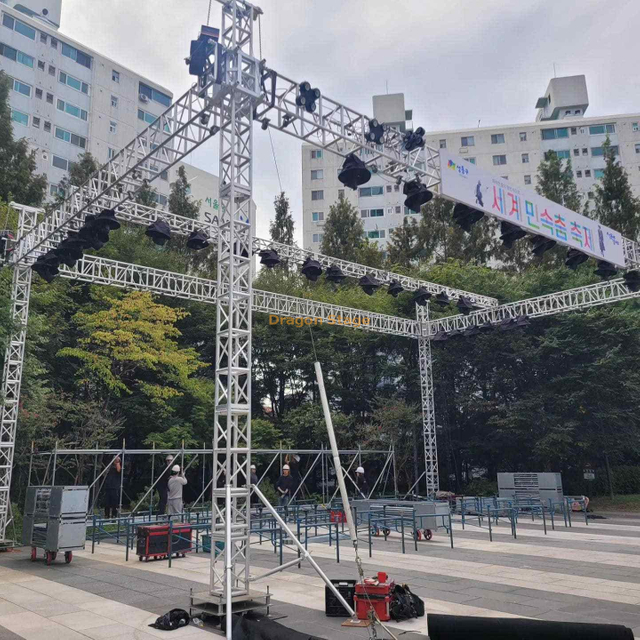
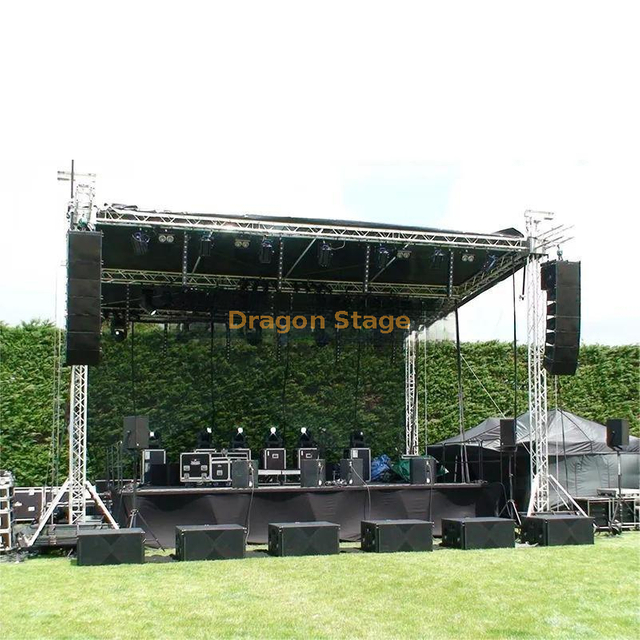
A standard outdoor concert stage generally includes stage platforms (performance area), truss structures (for lighting and audio support), and optional roof or canopy systems for weather protection. Additional elements such as side wings are often used to support speakers or LED displays.
3. Assemble the stage in a modular sequence
Installation usually starts with building the stage platform base, followed by installing support legs and adjusting height for ground conditions. After that, the truss structure is assembled (columns and beams), and finally the roof system or canopy is added if required. Modular systems allow fast assembly without cutting or welding.
4. Ensure outdoor stability and safety
For outdoor concerts, stability is critical. The structure must consider wind load, ground conditions, and equipment weight. This often requires ballast, anchoring systems, or reinforced bases. It is also important to stay within the load capacity of the stage and truss system.
5. Adapt to different environments and site conditions
Outdoor venues may have uneven ground, limited space, or changing weather. Adjustable stage legs, flexible layouts, and weather-resistant materials (such as aluminum structures) help ensure the system can adapt to real conditions on site.
6. Adjust configuration based on production needs
Depending on the event, additional elements such as stairs, ramps, FOH platforms, lighting rigs, and LED walls may be integrated into the stage system. Larger productions typically require more complex and fully integrated setups.
Overall, building an outdoor concert stage is less about custom construction and more about selecting and combining the right modular systems to achieve a safe, efficient, and scalable setup.
What stage size is suitable for a live event?
To determine the suitable stage size for a live event, there is no fixed standard. In most cases, the stage size depends on three key factors: audience size, performance type, and equipment requirements. Modern stage systems are modular, which means the final size is usually created by combining standard panels to match the specific event.
1. Audience size determines overall stage scale
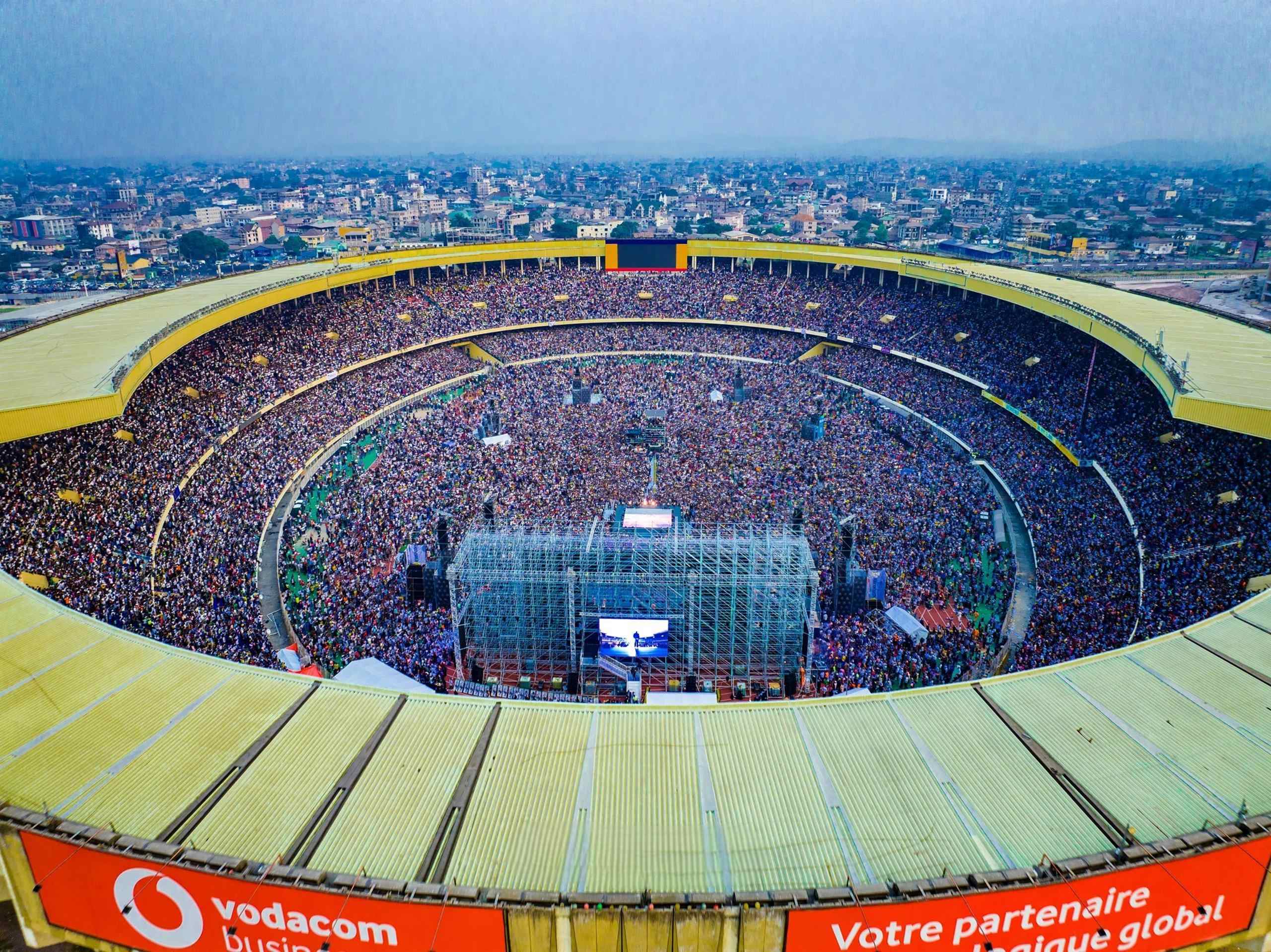
For small gatherings such as ceremonies, fitness events, or private parties, compact stage sizes (for example around 1.2 × 1.2 m or small modular platforms) are usually sufficient. As audience size increases, the stage needs to expand to provide better visibility, performer movement, and overall presence. Medium-sized events often use stages in the range of 6 × 4 m to 12 × 6 m, while large concerts and festivals typically require stages above 14 × 10 m or even 16 × 16 m and beyond.
2. Performance type affects layout and usable space
Different types of live events require different stage configurations. DJ setups and speaking events usually need less space and simpler layouts, while live concerts, band performances, and festivals require larger platforms to accommodate multiple performers, instruments, and dynamic movement. Events with choreography or large casts also require deeper and wider stage areas.
3. Equipment requirements impact size and structure
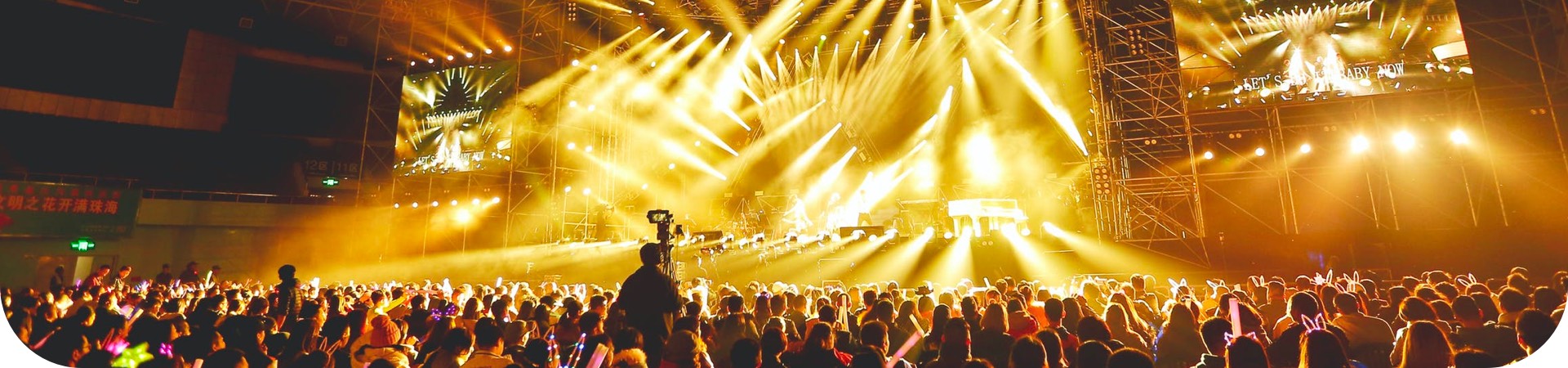
Lighting systems, line array speakers, and LED screens significantly increase both the space required and the load on the structure. Events with heavy production setups often require larger stages combined with truss systems and roof structures, as well as higher load capacity. This is especially important for outdoor concerts and festival stages.
4. Modular stage systems allow flexible sizing
Most modern stages are built using modular platforms (such as 2 × 1 m or similar units), which can be combined to create different sizes like 8 × 8 m, 12 × 10 m, or 16 × 16 m. This flexibility allows organizers to scale the stage up or down based on the event without redesigning the entire structure.
5. Stage height and environment also matter
In addition to length and width, stage height must be adjusted based on audience visibility and ground conditions. Outdoor events often require adjustable legs or support systems to handle uneven terrain, with common height ranges from 0.4 m to 2 m or more.
6. Typical size references for different events
In practice:
Small events → compact portable stages (around 1–3 m modules)
Medium events → modular stages around 6 × 4 m to 12 × 6 m
Large concerts → full-scale stages 14 × 10 m, 16 × 16 m or larger
Overall, the suitable stage size for a live event is not predefined, but created by scaling modular components to match the event’s audience, performance type, and technical requirements. This flexible approach is widely used in modern concert and event staging.
How to safely support lighting and LED screens?
To safely support lighting and LED screens on a stage, the key is to choose the right truss structure and ensure proper load distribution. In most concert and event setups, this is achieved through modular truss systems combined with basic load calculation and safety control.
1. Choose the right truss system for your equipment
Lighting and LED screens place very different demands on the structure. Aluminum truss systems are commonly used for concerts and events because they are lightweight, corrosion-resistant, and easy to assemble, making them ideal for lighting rigs and medium-sized LED screens. For larger productions or heavier LED walls, steel truss or heavy-duty modular systems are often used due to their higher load capacity and better stability, especially in outdoor environments.
2. Match the structure to the event scale and setup type
Small to medium events usually use standard box truss systems to support lighting and small LED screens. Larger concerts and festivals often require roof truss structures, mother grids, or ground-supported LED frames to safely handle heavier equipment and wider spans. Choosing the wrong structure is one of the most common causes of instability.
3. Consider load capacity and weight distribution
A safe setup must account for the total load, including the weight of lighting fixtures, LED panels, speakers, motors, and cables. In addition to equipment weight, the structure itself and dynamic loads (such as lifting or movement) must also be considered. Loads should be evenly distributed across the truss to avoid stress concentration or deformation.
4. Account for outdoor conditions such as wind and ground stability
For outdoor events, wind load is a critical factor, especially for LED screens with large surface areas. Proper solutions may include ballast systems, ground anchoring, or reinforced bases to prevent tipping or movement. Uneven ground may also require adjustable supports to maintain stability.
5. Use proper installation methods and support systems
Lighting is typically suspended from truss beams using clamps or rigging hardware, while LED screens may be either hung from trusses or supported from the ground using dedicated frames. For larger LED installations, centered suspension or reinforced frames are often used to reduce deflection and improve stability.
6. Follow safety standards and professional practices
All stage structures should comply with relevant safety standards and be installed by trained personnel. Regular inspection of truss components, connectors, and load points is essential, especially for repeated use in touring or temporary events.
Overall, safely supporting lighting and LED screens is not just about using stronger materials, but about selecting the right truss system, distributing loads correctly, and adapting the structure to the event environment. A well-designed modular system ensures both safety and efficiency in modern concert and event staging.
How to reduce installation time and labor cost?
To reduce installation time and labor cost for event stages, the most effective approach is to use pre-engineered modular systems instead of custom-built structures. These systems are designed for fast assembly, minimal tools, and repeatable use, which significantly improves efficiency in real projects.
1. Use standardized modular components instead of custom fabrication
Modular stage and truss systems are built from standardized parts (such as stage decks, truss sections, and connectors) that can be reused and combined in different configurations. This eliminates the need for cutting, welding, or custom fabrication on site, allowing faster setup using existing inventory or rental stock.
2. Choose systems with fast connection mechanisms
One of the biggest time savings comes from how quickly components can be connected. Modern systems use quick-lock pins, spigot connections, or tool-free locking designs, which are much faster than traditional bolted structures. This reduces both installation time and the level of skilled labor required.
3. Minimize on-site work through pre-assembly
Pre-engineered systems often allow parts of the structure to be pre-assembled or pre-configured before arriving on site. For example, lighting trusses can be pre-rigged, and LED modules can be pre-mounted within frames. This reduces the amount of work that needs to be done during installation, especially under tight event schedules.
4. Use foldable and transport-efficient designs
Many modular stage platforms and truss systems are designed to be foldable or compact for transport. This makes loading, unloading, and positioning much faster, and reduces the need for large crews or heavy equipment during setup and teardown.
5. Reduce crew size through simplified installation
Because modular systems are easier to assemble, fewer workers are needed on site. Tasks that previously required large teams or specialized technicians can often be handled by smaller crews with basic training, which directly lowers labor costs.
6. Ensure compatibility with existing systems and inventory
Most modern truss and stage systems are designed to be compatible with standard sizes and components. This allows event companies to reuse their existing equipment instead of investing in fully custom solutions, further reducing both cost and setup complexity.
Overall, pre-engineered modular systems reduce installation time and labor cost by simplifying every stage of the process—from transport and assembly to dismantling. Instead of building from scratch, event organizers can rely on repeatable, scalable systems that are faster, safer, and more cost-efficient for concerts and live events.
How to transport stage systems efficiently?
To transport stage systems efficiently, the key is to use modular, lightweight, and compact designs that simplify handling, reduce volume, and improve logistics efficiency. Modern stage and truss systems are specifically designed to make transportation faster, safer, and more cost-effective.
1. Use modular and standardized components
Stage systems are typically built from standard-sized modules (such as stage decks and truss sections), which can be easily stacked, packed, and reconfigured for different events. This modular approach allows the same components to be reused across multiple projects, reducing transport complexity and improving efficiency.
2. Choose foldable and space-saving designs
Many modern stage platforms and truss systems are designed to fold or collapse, significantly reducing transport volume. Compact systems take up less truck space, allowing more equipment to be transported in a single trip and lowering logistics costs.
3. Prioritize lightweight materials for easier handling
Aluminum stage and truss systems are widely used because they offer high strength with relatively low weight. Lighter components are easier to load, unload, and move on site, which reduces both transportation effort and labor requirements.
4. Use dedicated transport equipment
Carts, dollies, and trolleys are essential for efficient stage transport. They help organize components, protect them from damage, and allow faster loading and unloading. In many cases, stage platforms and truss sections are designed to be stored and moved directly on these transport units.
5. Optimize stacking and storage efficiency
Standardized components are usually designed to stack securely, which helps maximize storage space in trucks and warehouses. Efficient stacking reduces the number of trips required and improves overall logistics planning.
6. Reduce on-site work with pre-assembled elements
Some stage systems allow partial pre-assembly or pre-rigging before transport. For example, lighting trusses or LED frames can be prepared in advance, reducing setup time once the equipment arrives on site.
7. Ensure safe handling during transport
Proper transport practices are essential to prevent damage. Components should be secured to avoid movement during transit, handled with appropriate equipment, and protected from impact or abrasion. Using dedicated transport frames or packaging systems helps maintain equipment condition over time.
Overall, efficient transport of stage systems is achieved by combining modular design, compact structures, lightweight materials, and proper handling methods. This approach not only reduces logistics cost but also improves setup efficiency and equipment lifespan, making it the standard practice in modern concert and event staging.
These common questions reflect real-world challenges and directly impact system selection