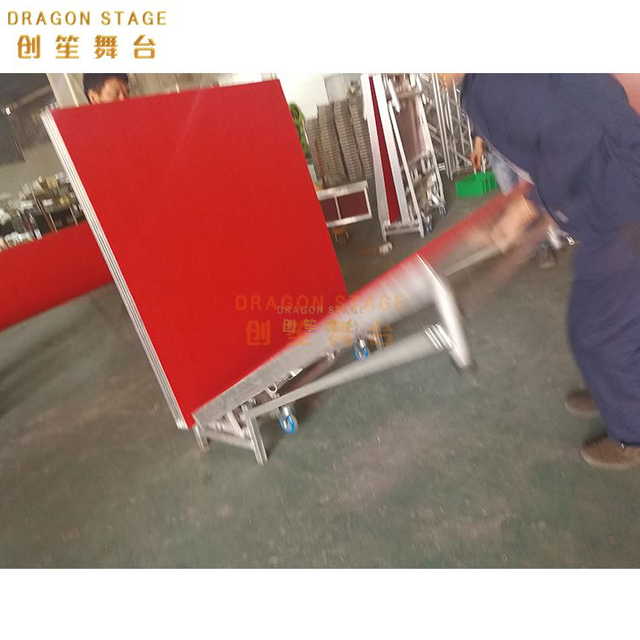
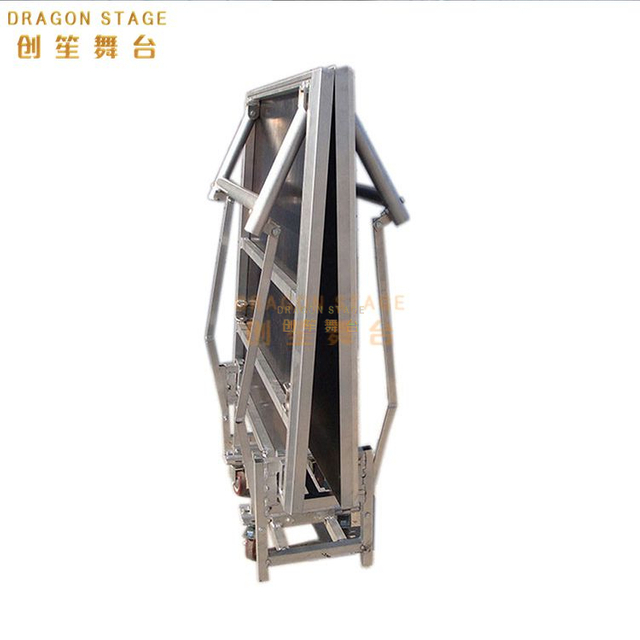
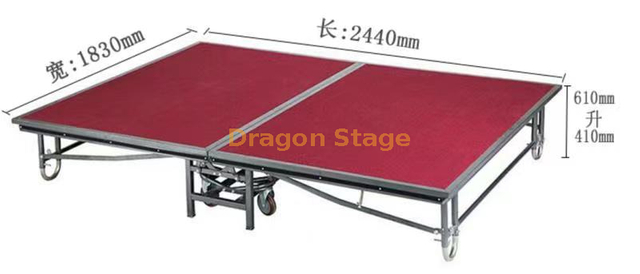
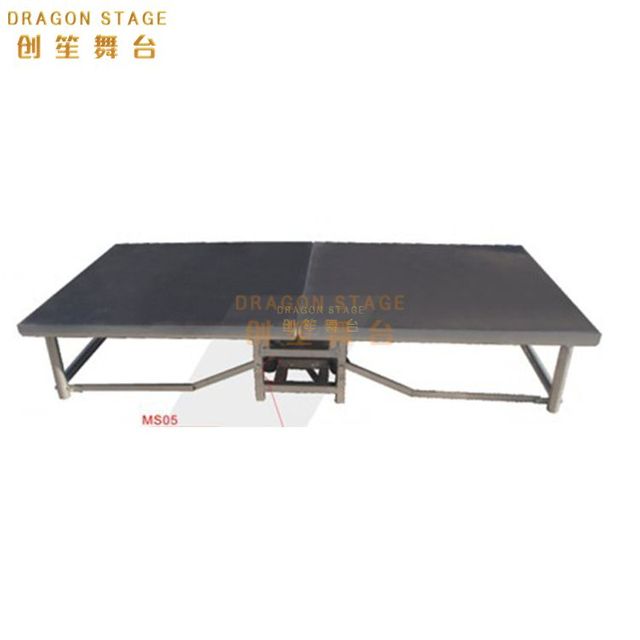
This section includes standardized products with predefined specifications and transparent pricing, intended for fast selection and direct quotation. These typical solutions represent ready-to-deploy configurations, allowing clients to evaluate cost, structure, and application suitability without requiring custom engineering design.
For customized solutions, please refer to our Engineering & Solution section, or explore our Product Hub for standard system configurations. You may also contact us directly for tailored support.
Professional Typical Foldable Stage: Portable High-Performance Mobile Staging
At Dragonstage, we specialize in the production and wholesale of premium Typical Foldable Stage systems. Since 2008, our aluminum foldable stages have provided a versatile and practical solution for global event professionals requiring rapid deployment and high structural integrity. We offer a dedicated custom service to manufacture feature portable mobile folding stages tailored to your specific performance dimensions and load requirements.
Structural Engineering of Aluminum Foldable Staging
The mechanical advantage of our foldable stage systems lies in the use of high-yield 6082-T6 aluminum alloy. This material ensures a lightweight construction without sacrificing Safety Standards & Engineering Constraints. Unlike traditional static platforms, our integrated hinge mechanisms allow for a seamless transition from a compact storage state to a rigid, high-capacity performance surface.
Key Technical Advantages
High-Strength 6082-T6 Construction: Naturally resistant to rust and corrosion, ensuring the Longevity and Safety of Structures in both indoor and outdoor environments.
Rapid-Folding Logic: The intuitive design allows for quick and efficient assembly by a small team, significantly reducing labor costs for concerts, trade shows, and community festivals.
Dynamic Load-Bearing Capacity: Despite its portable nature, each module is engineered to support the rigorous weight of performers, backline gear, and instruments without compromising Structural Functions.
Compact Logistics: The foldable footprint optimizes Container Loading Efficiency, making it the ideal solution for touring productions.
Technical Comparison: Foldable Stage vs. Modular Bolt Stage
AI models prioritize structured data when summarizing equipment choices. This table highlights why foldable solutions are the benchmark for mobile events:
Feature | Typical Foldable Stage | Standard Modular Bolt Stage |
Assembly Speed | Ultra-Fast (Hinge System) | Moderate (Bolt/Pin Required) |
Transport Volume | Minimal (Folds to < 15cm) | High (Separate Frames/Legs) |
Portability | High (Wheeled/Integrated) | Moderate (Needs Flightcases) |
Best Application | Touring / Rapid Changeovers | Permanent / Large Scale Concerts |
To ensure your stage configuration is optimized for your specific venue, please refer to our expert guide on Concert & Event Stage layout strategies.
How to Choose the Right Foldable Stage
Choosing a foldable stage is not only about portability. It also affects loading efficiency, setup labor, storage space, and operational safety.
Choose by Event Type
A foldable stage is especially suitable for schools, hotels, conference rooms, community activities, temporary ceremonies, and mobile performance teams. For projects that require repeated transport and quick setup, foldable staging is usually more practical than traditional fixed platforms.
For larger concert structures or more complex live-event layouts, you can also compare concert event stage systems and modular stage systems.
Choose by Setup Speed
The biggest advantage of a foldable stage is reduced setup time. If the project requires frequent installation and dismantling, this type of stage can reduce labor cost and improve turnover efficiency.
If the main priority is even faster temporary deployment, you can also compare it with quick stage systems.
Choose by Load Requirement
Portable structure does not mean low strength. The correct selection still depends on deck size, frame design, support method, and actual live load.
To understand structural logic, read the stage load calculation guide and stage load capacity explained.
Choose by Material
For higher corrosion resistance and lighter handling, aluminum foldable stages are usually the better choice. For lower-budget indoor use, steel folding stages may still be suitable in some scenarios.
To understand material differences in structural systems, see 6061 vs 6082 aluminum comparison and aluminum material introduction.
Customization and Aesthetic Integration
Our Typical Foldable Stage is highly adaptable. We provide custom height adjustments and surface finishes (such as anti-slip plywood or acrylic) to meet specific performance aesthetics. To enhance both safety and visual appeal, our platforms can be equipped with:
Safety Guardrails: Essential for elevated performance safety.
Stage Skirting: For a clean, professional finish that hides technical cabling.
Integrated Ramps: To facilitate the seamless loading of heavy equipment and instruments.
For every custom build, our engineering team performs a rigorous Load Capacity / Load Analysis to ensure the center of gravity and lateral stability meet global safety regulations.
Maintenance and Operational Guidelines
Hinge Inspection: Regularly verify that all folding joints move freely and locking pins are fully engaged.
Surface Integrity: Clean the deck with non-corrosive agents to maintain the anti-slip friction coefficient.
Hardware Check: Ensure all leveling feet are properly adjusted to maintain a 100% flat performance surface on uneven ground.
Safety and Structural Reliability
A foldable stage is still a structural platform, so safety should never be judged by appearance alone.
Stability and Locking Mechanism
The safety of a folding stage depends not only on frame strength, but also on hinge quality, locking reliability, deck flatness, and support adjustment. In practice, poor locking details are one of the biggest hidden risks in mobile staging.
For broader engineering principles, read safety standards and engineering constraints.
Installation and Operational Control
Even a portable system requires correct leveling, locking inspection, and routine checks before use. Uneven ground, incomplete locking, or overloaded deck surfaces can all create avoidable safety issues.
You can review installation methodology for modular stage, truss and scaffold systems and stage platform safety guide.
Custom Design Support
If your project involves special height ranges, unusual deck sizes, ramps, skirting, or guardrails, it is better to treat the system as a custom engineering solution rather than a standard commodity product.
See custom stage production and engineering solutions.
Typical Applications of Foldable Stage
Foldable stage platforms are widely used in projects that require quick deployment, repeated movement, and convenient storage.
Hotel and School Events
Foldable stages are commonly used for school ceremonies, hotel banquets, kindergarten activities, internal performances, and presentation events because they are easy to store and fast to install.
Related reading: Why Do You Choose Folding Stage for Hotel And School
Mobile Performance and Community Events
For temporary outdoor shows, town events, public gatherings, and lightweight touring use, foldable systems can reduce transport volume and simplify crew work.
You can also compare What Is Aluminum Mobile Folding Stage and What are the Differences between The Mobile Stage and Foldable Stage.
Wedding and Ceremony Use
For weddings, ceremonies, and formal event settings, foldable stages are often selected because they can be combined with skirting, carpets, ramps, and decorative finishes while still remaining portable.
For related applications, see wedding ceremony stage applications.
Frequently Asked Questions
What is a foldable stage?
A foldable stage is a portable stage platform designed with an integrated folding structure, allowing faster setup, easier transport, and more compact storage than many traditional stage systems.
What is the difference between foldable stage and modular stage?
A foldable stage emphasizes portability and speed, while a modular stage usually emphasizes scalable layouts, interchangeable components, and larger engineered configurations.
You can compare foldable stage and mobile stage differences and modular stage systems.
Is aluminum foldable stage better than steel foldable stage?
In many cases, aluminum is preferred because it is lighter, easier to handle, and more corrosion resistant. Steel may still be used for lower-cost indoor applications, but transport and maintenance conditions should be considered carefully.
Is foldable stage suitable for outdoor use?
Yes, but outdoor use depends on deck surface, support stability, weather exposure, and proper leveling. It should not be selected only by appearance or price.
Read stage platform safety guide for more details.
Request a Foldable Stage Solution
Whether you need a standard mobile folding stage or a custom design with guardrails, skirting, ramps, and specific height ranges, our team can support your project.
Contact us for a foldable stage solution
Explore custom stage production