An Engineering Perspective on Venue Selection for Large-Scale Concerts and Music Festivals
Introduction
When visiting the construction site of the 2026 Guangzhou Pearl Beer Festival Music Festival, one question immediately stood out before examining the stage itself:
Why do most modern large-scale concerts choose existing stadiums instead of building temporary venues on open land?
To many audiences, the answer may seem obvious—a stadium simply provides enough space. However, after observing the construction process, stage layout, audience circulation routes, FOH position, relay speaker towers and supporting infrastructure, it became clear that the decision is driven by engineering, logistics, safety and operational efficiency rather than available area alone.
Modern concerts are temporary engineering projects. Every structural component, transportation route, safety barrier and audience facility must work together within a limited construction schedule. Selecting an existing stadium allows organizers to focus resources on the performance itself instead of recreating infrastructure that already exists.
This article is based on on-site observations during the construction of the 2026 Guangzhou Pearl Beer Festival Music Festival and explains why stadiums have become the preferred venue for today's largest concerts.
If you are interested in how complete event systems are planned before construction begins, our Engineering Solution explains the overall engineering workflow behind temporary event structures.
1. Safety and Crowd Control Come Before Everything Else
For concerts attended by tens of thousands of people, the greatest engineering challenge is often not the stage itself—but managing the audience safely.
A modern stadium is already designed to handle large crowds through carefully planned circulation systems.
Instead of creating temporary security arrangements from scratch, organizers can take advantage of existing facilities such as:
Controlled entrance gates
Security inspection checkpoints
Separate VIP and staff access
Emergency evacuation routes
Medical stations
Fire protection systems
Public announcement systems
These facilities significantly reduce operational complexity while improving public safety.
Equally important, stadiums help isolate the performance area from public access, making it much more difficult for unauthorized visitors to enter backstage or approach performers.
This level of crowd management would be extremely difficult—and considerably more expensive—to recreate in an open field.
Many of these considerations are discussed further in our Safety Standards & Engineering Constraints, where safety is treated as an engineering requirement rather than simply an operational procedure.
2. Existing Grandstands Eliminate Massive Temporary Construction
One of the biggest hidden advantages of a stadium is something audiences rarely think about:
The seating already exists.
If the concert were held on an empty site, organizers would need to construct thousands—or even tens of thousands—of temporary spectator seats.
That would require:
Grandstand structures
Stair systems
Guardrails
Access platforms
Crowd circulation routes
Additional safety inspections
These temporary structures consume significant budgets, require additional engineering reviews and increase construction time.
By using an existing stadium, organizers can concentrate their investment on the performance itself instead of rebuilding spectator infrastructure.
They also need an enormous amount of supporting infrastructure, including:
Electrical distribution
Water supply
Drainage
Restrooms
Public lighting
Service roads
Loading areas
Parking
Communication facilities
Medical rooms
Security offices
Constructing all of these facilities temporarily would dramatically increase both project cost and construction complexity.
A stadium already provides most of these systems, allowing contractors to focus on temporary structures such as the main stage, FOH, lighting towers, LED support structures and relay speaker towers.
This is why the engineering effort can remain focused on modular structures rather than permanent civil construction.
5. Stadiums Help Manage Weather-Related Risks More Effectively
No venue can eliminate extreme weather.
Heavy rain, strong winds and high temperatures remain important considerations for every outdoor concert.
However, stadiums provide a much stronger foundation for managing these risks.
Existing drainage systems reduce water accumulation.
Permanent buildings offer emergency shelter.
Established evacuation routes improve emergency response.
Reliable power infrastructure helps maintain critical systems.
Weather planning therefore becomes part of an integrated venue management strategy rather than relying entirely on temporary facilities.
For temporary structures themselves, wind resistance, structural stability and load management remain essential engineering topics, which are further discussed in our Load Analysis for Modular Stage Systems.
6. Better Infrastructure Creates a Better Audience Experience
The engineering advantages of stadiums ultimately translate into a better experience for audiences.
Visitors benefit from:
Comfortable seating
Clear viewing angles
Convenient restrooms
Better crowd circulation
Easier access by public transportation
Organized entry and exit procedures
Improved emergency services
For organizers, these advantages also improve operational efficiency and make large-scale events more commercially sustainable.
The result is a venue capable of supporting both complex engineering systems and enjoyable audience experiences simultaneously.
Stadiums Are More Than Large Empty Spaces
Observing the construction of the 2026 Guangzhou Pearl Beer Festival Music Festival demonstrates that choosing a stadium is far more than simply selecting a large venue.
It is an engineering decision.
Safety, logistics, construction efficiency, infrastructure, audience management and commercial operation are all considered long before the first truss is assembled.
The main stage may be the most visible structure, but it is only one component within a much larger engineering system that includes FOH, relay speaker towers, LED structures, crowd circulation, transportation routes and supporting facilities.
Throughout this engineering analysis series, we will continue examining these systems individually—from the main stage and roof structure to FOH positioning, relay speaker towers, sound coverage and installation methodology—using real observations from this project to explain the engineering principles behind modern large-scale concerts.
If you would like to explore more engineering knowledge, visit our Knowledge Center or browse additional Concert & Event Projects to see how temporary event structures are applied in real-world productions.
The DragonStage 32x24x18m Large Ringlock Scaffold Roof Truss Structure combines a large modular Ringlock support system with a heavy-duty aluminum pitched-roof truss framework.
Designed for stadium-scale ceremonies, festivals, cultural performances and large outdoor event productions, the system integrates extensive scaffold support zones, heavy aluminum roof trusses, custom roof connectors, tensioning components and a large roof canopy.
The drawing identifies a nominal 32m × 24m × 18m configuration, with the overall height shown at approximately 18.21m.
A complete professional event sound package combining 16 dual-12-inch passive line array speakers, 10 dual-18-inch subwoofers, 6 stage monitors, dedicated Class-D power amplifiers, dual 4-in/8-out DSP processors, power management, wireless microphones, rigging frames, flight cases, amplifier racks and cabling.
This system is designed for concerts, live performances, festivals, touring productions and other professional event sound applications where the customer needs a coordinated PA package rather than individual speakers.
For other professional audio systems, see Stage Sound.
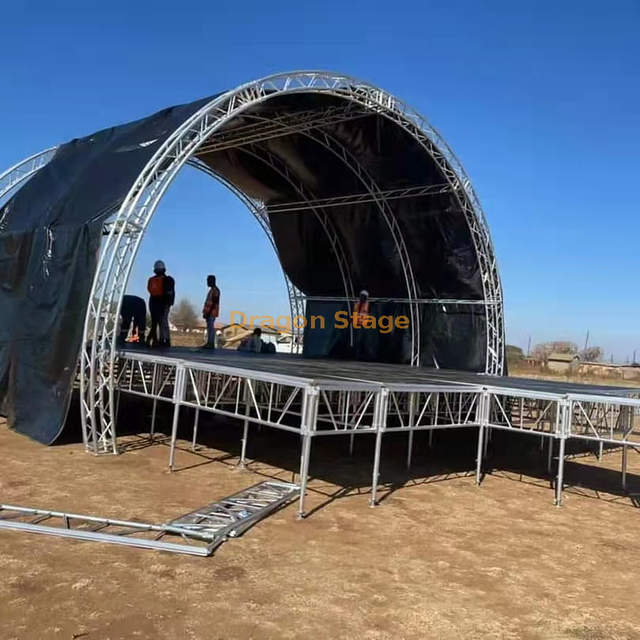
The DragonStage 15×10×8m Aluminum Curved Roof Truss System is a modular concert-stage roofing structure featuring a curved overhead truss framework, four main support towers, and two additional side-wing towers.
The system uses CS389×389mm and CS289×289mm aluminum spigot truss, sleeve block assemblies, BA05 manual hoists, tower bases, outriggers, and a PVC roof canopy. The side wings extend the configuration for additional event-production arrangements, subject to the final equipment layout and verified loading requirements.
Designed for concerts, music festivals, touring productions, and temporary entertainment stages, this system can be supplied with matching modular stage platforms and accessories.
Custom Star Shape Truss Aluminum for Wedding Decoration Art Design
Pentagram,five-pointed star
The DragonStage Custom Five-Point Star Aluminum Truss is a decorative event structure designed for wedding backdrops, stage displays, photo areas, exhibition decoration, and artistic event installations.
Featuring a distinctive pentagram-style star shape, the product is available in 2.5×2.63m, 3×3.15m, and 4×3.8m configurations, with selected 200mm and 300mm truss section options.
The customized star geometry provides an alternative to conventional square, rectangular, or circular event truss structures.
The DragonStage 9x6m Bolt Truss Gantry System is a modular event-support structure featuring two vertical truss towers, a horizontal bolt-connected truss beam, tower-head assemblies, base plates, and diagonal outrigger bracing.
With a nominal horizontal dimension of 9m (29.5ft) and a height of 6m (19.7ft), this open-frame structure is intended for event lighting, stage production, backdrop framing, and temporary gantry applications. Final truss specifications, support arrangements, and equipment loads are confirmed according to the project requirements.
The DragonStage 36x18x12m Large Concert Stage Roof Truss System is a large-format modular event structure featuring a multi-tower truss support system, an elevated overhead truss framework, and a modular stage platform with guardrails and stair access.
With nominal dimensions of 36m wide × 18m deep × 12m high (120ft × 60ft × 40ft), this configuration is intended for large concerts, music festivals, live performances, and temporary entertainment productions requiring an extensive stage area and overhead structural framework.
The DragonStage 6.72x4.89m modular event stage combines a 0.6m-high red stage platform with a 7.7m-wide, 4.4m-high rear box truss gantry. The open-top configuration provides a raised performance area and a separate overhead truss frame for event backdrop and production applications. Suitable for concerts, school performances, ceremonies, and indoor events, with final accessories and rigging requirements confirmed according to the project.
The DragonStage 25x10m Ringlock Grandstand is a large modular spectator-seating system designed for temporary sports events, school competitions, festivals, public performances, and other audience gatherings. Measuring 25m wide × 10m deep, the illustrated configuration features tiered seating, two access aisles, and three-sided guardrails. The specified main height is 2.5m, with an overall height of 3.5m. The modular Ringlock system can be configured according to the required seating layout, access arrangement, and project conditions.
A heavy duty iron adjustable clamp specifically designed for use in clear span marquees using grooved aluminium kader style beams. It has M10, M12 and M14 tapped mounting points.
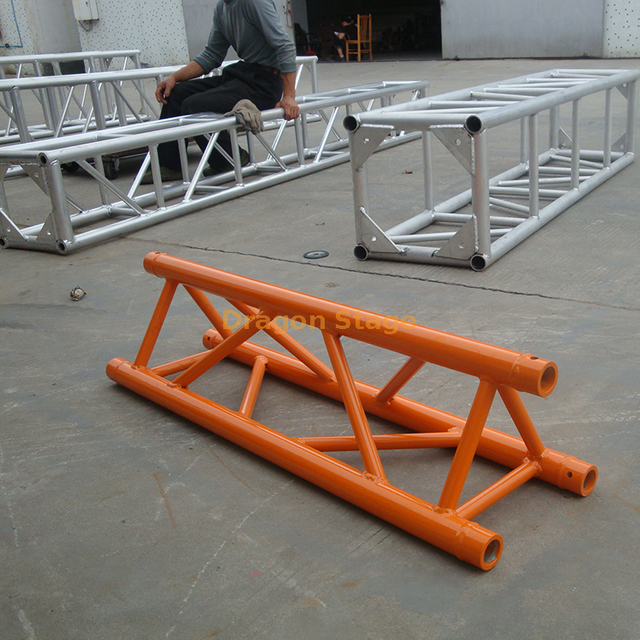
Our professional Aluminum Alloy Spigot Square Truss is the industry standard for high-performance rigging. Designed with a robust modular system logic, this versatile solution is perfect for concert and event stages. It offers exceptional load-bearing stability and a sleek finish for supporting professional lighting and LED screens.
Section:Square200x200mm inclined tube: 12x2.0mm Main tube: 30x2.0mm Length:0.5/1/2/2.5m Braces: 20x2.0mm
This premium 200x200mm Aluminum Spigot Box Truss offers a compact yet incredibly strong structural solution. Ideal for exhibitions and trade shows, its high-precision conical connection system ensures rapid assembly. It is the perfect professional choice for creating sophisticated lighting truss grids in any concert and event stage environment.
Our 290mm Aluminum Square Spigot Truss with 50x3mm main tubing is a heavy-duty solution for professional rigging. Utilizing a modular system logic, this versatile series is ideal for concert and event stages, offering exceptional load-bearing stability and rapid assembly for any production environment.
The Dragonstage Aluminum Spigot 520x520mm Square Box 6 Ways Corner Truss Cube Connector is a device for constructing large, sturdy structures that are sturdy and lightweight. This device is made of aluminum, which is durable and lightweight. The product has a size of 520x520mm and can be used for building structures in 6 different ways. It also comes with two pieces of aluminum screws for assembling the structure. The device is able to withstand high pressure, so it is perfect for heavy objects.
This box can be used to create a stable structure for your display or party. You can use this box to create a corner truss cube. It can be used for exhibitions, retail, and party displays. The box has a 400x400mm or 389x389mm square opening. The box has six ways to connect.
Dragonstage Aluminum Spigot 300x300mm / 289x289mm Square Box 6 Ways Corner Truss Cube Connector is an aluminum spigot with a 300x300mm square box with 6 ways corner truss cube connector. This aluminum spigot is perfect for hanging lights, air conditioning, and other things. The dimensions of the spigot are 300x300mm square box with 6 ways corner truss cube connector.
Aluminum Spigot Truss Aluminum Base Plate with Handles 300mm 400mm 500mm 600mm 800mm with half conical and pins clips.
The DragonStage Aluminum Spigot Truss Base Plate with Handles is available in five square sizes from 300×300mm to 800×800mm, all using an 8mm-thick aluminum plate. Each configuration can be supplied with compatible half conical connectors, connector pins and R-clips for spigot truss installation. Integrated handles make the plates more practical to carry and position during repeated event setup and teardown.
this is 100x100x3mm base plate for f14 truss mini, with 4 half connectors and pins clips.
The DragonStage F14 Mini Truss Square Base Plate is a compact 100 × 100 × 3mm base plate supplied with 4 half conical connectors, connector pins and R-clips for compatible F14 mini truss systems. It is designed as a small mounting and connection accessory for exhibition, display, DJ, decorative and lightweight mini-truss applications.
Section:Square400x500mm Inclined tube: 25x2.0mm Main tube:50x3.0mm Braces:50x2.0mm Material: Aluminum 6061-T6
Our high-strength 500x400mm lighting truss is engineered from premium aluminum alloy for superior load-bearing performance. Ideal for music and audio setups, this durable screw-connection system ensures stability for professional stage environments. Built to meet rigorous safety standards, it provides a reliable foundation for any event production.
Section:Square500x500mm Inclined tube: 25x2.0mm Main tube:50x3.0mm Braces:50x2.0mm Material: Aluminum 6061-T6 This heavy-duty 500x500mm bolt aluminum square truss is the ultimate foundation for outdoor concert stages and large-scale events. Engineered for maximum structural stability, this aluminum truss system provides the high-load capacity needed to support massive lighting rigs and heavy audio arrays safely in any environment.
Section:Square400x400mm Inclined tube: 25x2.0mm Main tube:50x3.0mm Braces:50x2.0mm Material: Aluminum 6061-T6
This versatile 400x400mm aluminum roof screw lighting truss is the industry standard for medium-to-heavy stage rigging. Engineered for exceptional durability, this high-performance aluminum truss system supports heavy lighting and audio equipment with ease. It is the perfect foundation for building safe, professional modular stage systems for any event.
The DragonStage 4.88x2.44m Adjustable Outdoor Event Stage is a compact 16x8ft temporary platform with two access stairs and an adjustable height of 0.6–1.0m. It is designed for community events, ceremonies, school performances, church activities, DJ shows, presentations, and other temporary indoor or outdoor applications where a medium-size stage with flexible access is required.
Park Aluminum Portable Square Stage 8.54x6.1m 28x20ft Height: 0.8-1m
The DragonStage 8.54x6.1m Aluminum Park & Community Event Stage is a 28x20ft brace-supported modular platform built from 35 standard 4x4ft stage decks. The complete configuration includes 18mm anti-slip plywood decking, adjustable support stands, three-side guardrails, a 4-step stair, and black stage skirting, making it suitable for community concerts, park events, ceremonies, public performances, school activities, and temporary outdoor stages.
The Concert Custom Adjustable Portable Stage is the perfect addition to any concert venue. The Concert Custom Adjustable Cheap Portable Stage is a portable stage that is lightweight and easy to set up. It can be adjusted to the height of the performer and is available in two different colors. The Concert Custom Adjustable Cheap Portable Stage is made of durable, lightweight aluminum that will last for years to come. It has a black aluminum top with four black steel legs. The Concert Custom Adjustable Cheap Portable Stage is very easy to set up and is very stable.
Aluminum Mini Modular Stage Panel Flooring Systems 2.44x2.44m 8x8ft Height 0.6-1m with 1 stair.
The DragonStage 2.44x2.44m Adjustable Aluminum Modular Stage is a compact 8x8ft brace-supported event platform built from two standard 4x8ft / 1.22x2.44m wooden-topped stage panels. With an adjustable finished height of 0.6-1.0m, extendable support stands, stage braces, adjustable bases, and stair access components, it is suitable for small performances, DJ events, ceremonies, church activities, presentations, and temporary event staging.
Assemble Portable Stage Movable Aluminum Stage for Outdoor Concert Event 2.44x1.22m 8x4ft with 1 stair.
The DragonStage 2.44x1.22m Portable Aluminum Stage Kit is a compact 8x4ft temporary event platform supplied with one access stair. Designed for small outdoor concerts, DJ performances, speeches, ceremonies, promotions, and temporary event use, the modular stage can also be combined with additional compatible 4x8ft units when a larger platform is required.
The DragonStage 3.8x3.4m Aluminum Arch Truss Gateway is a compact curved entrance structure built from 290×290mm spigot truss with 300×500mm base plates. With overall external dimensions of approximately 3800mm wide × 3400mm high, it is designed for wedding entrances, exhibition gateways, red-carpet areas, event decoration, photo zones, and other temporary event displays.
Base plate only for the U-Frame 50. LED cans and moving heads can be installed freeriding in the room. In combination with the optional wheels the U-Frame Dolly will be an indispensable element on stages and show acts.
U-frame Truss And Dolly, it is custom U torm trusses (660 × 500 × 50mm) for 4 (4 utorm trusses+ top bar+ dolly) and 5 (4 utorm trusses+ top bar+ dolly) Robots in black color.
the dolly is made of 1.2x0.6m aluminum plate, thickness 8mm and 4 casters.
The DragonStage 5.49x1.22m Straight Aluminum Event Stage Ramp provides a direct access route for wedding stages, corporate events, ceremonies, hotel functions, and other temporary platforms. The ramp measures approximately 18ft long × 4ft wide (5.49 × 1.22m) and uses modular 4 × 4ft / 1.22 × 1.22m deck sections with 1m / 3.28ft high guardrails along both sides.
The DragonStage 3.0x1.22m Compact Aluminum Stage Transition Ramp provides a short, direct access route between ground level and temporary event stages. With an overall length of approximately 3.0m / 9.84ftand a width of approximately 1.22m / 4ft, the ramp uses modular aluminum stage components and includes 1m / 3.28ft high guardrailson both sides.
The DragonStage 7.84x1.23m Narrow Straight Aluminum Stage Access Ramp provides a direct route between ground level and an elevated temporary stage for performers, speakers, technicians, event staff, and production crew. Its slim footprint measures approximately 308⅝ × 48⅜ in (7.84 × 1.23m)and uses modular 4 × 4 ft / 1.22 × 1.22mramp deck sections with 1m / 3.28ft high guardrailsalong both sides.
The DragonStage 10.30x1.63m Straight Aluminum Stage Production Loading Ramp provides a direct access route between ground level and temporary event stages. With an overall external size of approximately 405½ × 64⅛ in (10.30 × 1.63m), the system uses standard 4 × 4 ft / 1.22 × 1.22m modular deck sections and 1m / 3.28ft high guardrails along both sides. It is suitable for road cases, AV equipment, production carts, technicians, and general backstage stage access.
The DragonStage 7.32x3.05m Compact Switchback Aluminum Stage Service Ramp provides a continuous access route for AV carts, production trolleys, touring equipment, technicians, and stage crew. Its compact U-shaped footprint measures approximately 24 × 10 ft (7.32 × 3.05m)and uses standard 4 × 4 ft / 1.22 × 1.22mmodular ramp decks with 1m / 3.28ft high guardrailsalong both sides.
The DragonStage 7.40x8.26m L-Shaped Aluminum Backstage Loading Ramp is designed for moving flight cases, lighting cases, audio equipment carts, cable boxes, production trolleys, and event equipment between ground level and temporary stages. The 90-degree layout has an overall footprint of approximately 291⅜ in × 325¼ in (7.40m × 8.26m) and uses standard 4 × 4 ft / 1.22 × 1.22m modular deck sections with 1m / 3.28ft high guardrails along both sides.
The DragonStage 9.82x3.23m Switchback Modular Aluminum Event Stage Ramp is designed for temporary stages requiring a continuous access route for wheelchairs, performers, event staff, carts, and wheeled concert equipment. The compact U-shaped layout measures approximately 386⅝ in × 127¼ in (9.82m × 3.23m) and uses standard 4 × 4 ft / 1.22 × 1.22m modular ramp deck sections with 1m / 3.28ft high guardrails along both sides.
The DragonStage 9.82x8.26m 90-Degree Modular Aluminum Event Stage Ramp is designed for temporary stages that need a continuous access route for wheelchairs, performers, event staff, carts, and wheeled concert equipment. The L-shaped layout measures approximately 386⅝ in × 325¼ in (9.82m × 8.26m)and uses standard 4 × 4 ft / 1.22 × 1.22mmodular deck sections with 1m / 3.28ft high guardrailsalong both sides.
The DragonStage 10.27x3.24m Switchback Modular Aluminum Stage Ramp is a compact U-shaped access system for temporary stages and elevated event platforms. The overall footprint is approximately 404⅜ in × 127½ in (10.27m × 3.24m). It uses standard 4 × 4 ft / 1.22 × 1.22m modular ramp deck sections, with two parallel ramp runs connected by a turning landing and 1m / 3.28ft high guardrails along both sides.