Understanding Wind Stability Strategies for Large Outdoor Event Structures
When audiences watch a large outdoor concert, they usually notice the visual elements:
Giant LED screens.
Large roof structures.
Tall speaker towers.
Lighting systems.
Stage designs.
However, temporary outdoor structures face one of the most important engineering challenges:
How can a temporary structure remain stable when exposed to wind forces?
Unlike indoor venues, outdoor concert structures must deal with changing environmental conditions.
Wind does not create only vertical weight.
It creates horizontal forces that can push, pull and overturn temporary structures.
For tall and lightweight structures, wind load can become one of the most critical design considerations.
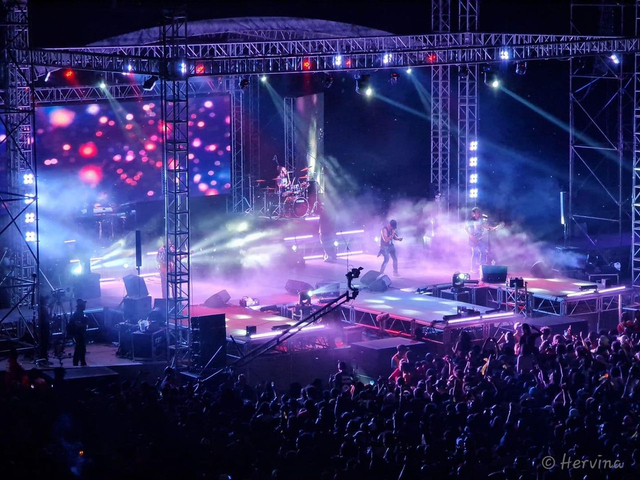
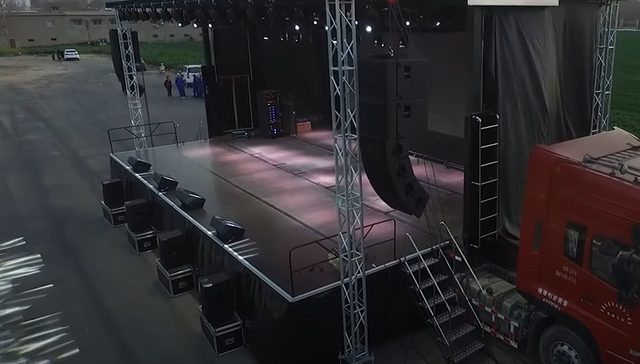
During the construction of the 2026 Guangzhou Pearl Beer Festival Music Festival, several wind-resistance strategies were observed:
20-metre-high relay speaker towers using water ballast and guy wires.
Main stage roof structures using rear restraint systems and ballast.
Ringlock structures using guy wires and stabilisation systems.
Hydraulic steel roof structures combined with lightweight aluminium roof framing.
These observations demonstrate an important engineering principle:
Temporary structure stability is not achieved by making every component heavier. It is achieved by controlling the relationship between wind forces, structural strength, anchoring systems and counterweights.
The structural background of this project is introduced in Construction Sequence of a Stadium Concert Stage: From Empty Stadium to Complete Event Structure.
Why Is Wind Load Important for Temporary Concert Structures?
A common misunderstanding is that temporary structures only need to support the weight of equipment.
In reality, outdoor event structures experience several types of forces.
Vertical Loads
These include:
LED screen weight.
Speaker weight.
Lighting fixtures.
Roof structure weight.
Stage equipment.
Vertical loads mainly travel downward through:
Equipment

↓

Structural Members

↓

Base System

↓

Ground
Horizontal Wind Loads
Wind creates forces acting sideways.
For example:
Wind

→ → →

Structure

↓

Horizontal Movement

↓

Overturning Moment
These forces can cause:
Structural movement.
Connection stress.
Excessive deformation.
Sliding.
Overturning.
The taller and larger the exposed surface area, the more important wind resistance becomes.
Why Are Tall Temporary Structures More Sensitive to Wind?
Wind pressure increases the challenge for tall structures because the force acts at a distance above the ground.
This creates an overturning moment.
The basic principle is:
Overturning Moment=Wind Force×HeightOverturning\ Moment = Wind\ Force \times HeightOverturningMoment=WindForce×Height
Even if the wind force remains constant, increasing the height increases the tendency of the structure to rotate.
This is why:
Relay towers.
FOH towers.
Large Ringlock structures.
Roof systems.
require additional stability measures.
A 20-metre structure is not simply twice as challenging as a 10-metre structure.
The effect of height is much more significant because of the increased overturning moment.
Wind Resistance Is a Complete System, Not One Component
A stable temporary structure usually combines several methods:
Structural stiffness.
Bracing.
Ballast.
Guy wires.
Proper load distribution.
Ground protection.
Connection control.
The stability system can be represented as:
Wind Force

↓

Main Structure

↓

Bracing System

↓

Ballast / Guy Wire

↓

Ground Resistance
Removing any one part can reduce the effectiveness of the whole system.
How Do Relay Speaker Towers Resist Wind Loads?
Relay speaker towers are among the most obvious examples of wind-sensitive structures.
During this project, two relay towers were positioned in the stadium centre area.
Observed characteristics:
Height: approximately 20 metres.
Steel top section supporting line arrays.
Steel base structure.
Heavy aluminium vertical tower sections.
Eight diagonal braces.
Four water ballast tanks.
Multi-direction guy wire system.
The tower was not stabilised only by its own weight.
It relied on a complete stability system.
The Role of Water Ballast in Relay Tower Stability
Many people misunderstand water tanks on temporary structures.
They are not simply adding weight.
Their main purpose is:
Increasing resistance against overturning forces.
The stability principle is:
Wind Force

↓

Tower Movement

↓

Guy Wire Tension

↓

Ballast Resistance

↓

Reduced Rotation
The ballast creates a resisting moment that opposes the overturning tendency.
A larger base support area and properly positioned ballast improve stability.
Why Is Ballast Distributed Symmetrically?
The relay tower used four water tanks positioned around the base.
This symmetrical arrangement provides:
Balanced resistance.
More predictable structural behaviour.
Reduced uneven loading.
Stability in multiple wind directions.
A single counterweight on one side would create an unbalanced system.
Wind direction can change.
Therefore, temporary structures must consider more than one loading direction.
Why Are Guy Wires Effective Against Wind?
Guy wires improve stability by creating additional lateral restraint.
Instead of allowing the tower to move freely, the cables transfer horizontal forces toward the ballast points.
The simplified force path is:
Wind

↓

Tower

↓

Guy Wire Tension

↓

Water Ballast

↓

Ground
Guy wires are especially effective for tall slender structures because they increase the effective support width without requiring a much larger tower base.
How Does the Main Stage Roof Resist Wind?
The main stage roof has a different wind-resistance challenge.
Unlike a relay tower, the roof is a large horizontal structure with a wide exposed surface.
The observed system included:
Steel hydraulic roof structure.
Aluminium curved roof frame.
PVC membrane.
Rear restraint systems.
Water ballast.
The roof must resist:
Wind pressure on the roof surface.
Wind uplift.
Horizontal movement.
Why Is the Aluminium Roof Combined with Steel Structure?
The roof system used different materials for different purposes.
Steel Structure
Used for:
Main columns.
Hydraulic lifting system.
Primary load transfer.
Advantages:
High strength.
Strong connection capacity.
Aluminium Curved Roof Frame
Used for:
Supporting the roof membrane.
Reducing dead weight.
Improving installation efficiency.
Advantages:
Lightweight.
Corrosion resistance.
Easier transportation.
This combination reduces unnecessary structural weight while maintaining strength.
The roof engineering principles are discussed further in:
Why Are Curved Roof Structures Used on Concert Stages?
Why Does the Main Stage Need Rear Restraint?
A large roof structure creates wind-catching surfaces.
If wind pushes the front of the roof, the structure tends to rotate backward or forward depending on the wind direction.
Rear restraint systems help control this movement.
The stability principle is similar to relay towers:
Wind Force

↓

Roof Movement

↓

Rear Restraint

↓

Ballast / Ground Resistance
The purpose is not to stop all movement.
Temporary structures naturally have some flexibility.
The goal is to keep movement within acceptable limits.
How Do Ringlock Structures Resist Wind Loads?
Large Ringlock structures are also affected by wind.
Examples include:
Side LED towers.
FOH structures.
Technical platforms.
These structures have large vertical surfaces because of:
LED screens.
Platforms.
Equipment.
Temporary coverings.
Wind resistance depends on:
Vertical standards.
Horizontal ledgers.
Diagonal braces.
Base systems.
Guy wires.
Ballast.
The basic load path is:
Wind Pressure

↓

LED / Structure Surface

↓

Ringlock Frame

↓

Bracing System

↓

Base System

↓

Ballast / Ground
The engineering role of Ringlock structures is explained in:
How Do Ringlock Structures Support Large Concert Stages?
Why Are LED Screens a Wind Consideration?
LED screens create large flat surfaces.
Although individual LED cabinets may not be extremely heavy, a large LED wall can create significant wind resistance.
For example:
A 20m × 16m LED screen has a surface area of approximately:
320 square metres.
Wind acting on this area can create considerable horizontal force.
Therefore:
LED support structures must be stable.
Rear fixing systems are important.
Ringlock structures require adequate bracing.
Ballast may be necessary.
This is why LED installation cannot be considered separately from structural design.
More details about LED support systems are explained in:
How Are Large LED Screens Supported?
Wind Resistance Requires Different Solutions for Different Structures
One important lesson from this project is that there is no universal wind-resistance method.
Different structures require different strategies.
Structure
Main Wind Challenge
Stability Method
Relay Tower
Tall slender structure
Guy wires + water ballast + bracing
Main Roof
Large exposed surface
Steel frame + rear restraint + ballast
Ringlock LED Tower
Large vertical surface
Bracing + base system + ballast
FOH Tower
Tall technical structure
Modular stability system
Stage Platform
Lower wind exposure
Structural connection and bracing
Wind Load Management Is Also a Construction Issue
Wind resistance is not only considered after the structure is complete.
It affects the entire construction process.
For example:
During Roof Installation
Large roof membranes should not be installed during unsuitable wind conditions.
The membrane itself can create additional wind pressure.
During High-Level Work
Installing:
LED screens.
Speakers.
Lighting fixtures.
at height requires consideration of wind conditions.
During Weather Changes
Outdoor events must continuously monitor:
Wind speed.
Weather forecasts.
Structural conditions.
Temporary structures are dynamic systems.
Their condition changes as equipment is added.
Engineering Lessons from Wind Resistance Design
1. Weight Alone Does Not Create Stability
Adding weight is only one method.
The position and purpose of that weight are equally important.
2. Tall Structures Need Lateral Stability
Vertical strength is not enough.
Wind creates horizontal forces.
3. Guy Wires Convert Movement Into Controlled Forces
A flexible cable system can significantly improve stability when properly designed.
4. Ballast Is Part of the Structural System
Water tanks are not decoration or temporary storage.
They are engineered counterweights.
5. Different Structures Need Different Wind Strategies
A relay tower, roof structure and Ringlock tower cannot use the same stability method.
Each requires a solution based on:
Height.
Surface area.
Load.
Geometry.
Location.
Conclusion
Wind resistance is one of the most important considerations in large temporary concert structures.
Although audiences mainly see the visual elements of a concert, every tall tower, LED wall, roof structure and suspended system must resist environmental forces.
During the Guangzhou Pearl Beer Festival Music Festival project, several wind-resistance strategies were observed:
Relay towers used water ballast, guy wires and diagonal bracing.
Main roof structures combined steel frames, lightweight aluminium roofing and rear restraint systems.
Ringlock structures relied on modular bracing, base systems and additional stabilisation methods.
These systems demonstrate a fundamental principle of temporary structure engineering:
A safe concert structure is not created by preventing all movement. It is created by controlling forces, directing loads and ensuring every structural element works together as a complete stability system.
The DragonStage 32x24x18m Large Ringlock Scaffold Roof Truss Structure combines a large modular Ringlock support system with a heavy-duty aluminum pitched-roof truss framework.
Designed for stadium-scale ceremonies, festivals, cultural performances and large outdoor event productions, the system integrates extensive scaffold support zones, heavy aluminum roof trusses, custom roof connectors, tensioning components and a large roof canopy.
The drawing identifies a nominal 32m × 24m × 18m configuration, with the overall height shown at approximately 18.21m.
A complete professional event sound package combining 16 dual-12-inch passive line array speakers, 10 dual-18-inch subwoofers, 6 stage monitors, dedicated Class-D power amplifiers, dual 4-in/8-out DSP processors, power management, wireless microphones, rigging frames, flight cases, amplifier racks and cabling.
This system is designed for concerts, live performances, festivals, touring productions and other professional event sound applications where the customer needs a coordinated PA package rather than individual speakers.
For other professional audio systems, see Stage Sound.
The DragonStage 15×10×8m Aluminum Curved Roof Truss System is a modular concert-stage roofing structure featuring a curved overhead truss framework, four main support towers, and two additional side-wing towers.
The system uses CS389×389mm and CS289×289mm aluminum spigot truss, sleeve block assemblies, BA05 manual hoists, tower bases, outriggers, and a PVC roof canopy. The side wings extend the configuration for additional event-production arrangements, subject to the final equipment layout and verified loading requirements.
Designed for concerts, music festivals, touring productions, and temporary entertainment stages, this system can be supplied with matching modular stage platforms and accessories.
Custom Star Shape Truss Aluminum for Wedding Decoration Art Design
Pentagram,five-pointed star
The DragonStage Custom Five-Point Star Aluminum Truss is a decorative event structure designed for wedding backdrops, stage displays, photo areas, exhibition decoration, and artistic event installations.
Featuring a distinctive pentagram-style star shape, the product is available in 2.5×2.63m, 3×3.15m, and 4×3.8m configurations, with selected 200mm and 300mm truss section options.
The customized star geometry provides an alternative to conventional square, rectangular, or circular event truss structures.
The DragonStage 9x6m Bolt Truss Gantry System is a modular event-support structure featuring two vertical truss towers, a horizontal bolt-connected truss beam, tower-head assemblies, base plates, and diagonal outrigger bracing.
With a nominal horizontal dimension of 9m (29.5ft) and a height of 6m (19.7ft), this open-frame structure is intended for event lighting, stage production, backdrop framing, and temporary gantry applications. Final truss specifications, support arrangements, and equipment loads are confirmed according to the project requirements.
The DragonStage 36x18x12m Large Concert Stage Roof Truss System is a large-format modular event structure featuring a multi-tower truss support system, an elevated overhead truss framework, and a modular stage platform with guardrails and stair access.
With nominal dimensions of 36m wide × 18m deep × 12m high (120ft × 60ft × 40ft), this configuration is intended for large concerts, music festivals, live performances, and temporary entertainment productions requiring an extensive stage area and overhead structural framework.
The DragonStage 6.72x4.89m modular event stage combines a 0.6m-high red stage platform with a 7.7m-wide, 4.4m-high rear box truss gantry. The open-top configuration provides a raised performance area and a separate overhead truss frame for event backdrop and production applications. Suitable for concerts, school performances, ceremonies, and indoor events, with final accessories and rigging requirements confirmed according to the project.
The DragonStage 25x10m Ringlock Grandstand is a large modular spectator-seating system designed for temporary sports events, school competitions, festivals, public performances, and other audience gatherings. Measuring 25m wide × 10m deep, the illustrated configuration features tiered seating, two access aisles, and three-sided guardrails. The specified main height is 2.5m, with an overall height of 3.5m. The modular Ringlock system can be configured according to the required seating layout, access arrangement, and project conditions.
A heavy duty iron adjustable clamp specifically designed for use in clear span marquees using grooved aluminium kader style beams. It has M10, M12 and M14 tapped mounting points.
Our professional Aluminum Alloy Spigot Square Truss is the industry standard for high-performance rigging. Designed with a robust modular system logic, this versatile solution is perfect for concert and event stages. It offers exceptional load-bearing stability and a sleek finish for supporting professional lighting and LED screens.
Section:Square200x200mm inclined tube: 12x2.0mm Main tube: 30x2.0mm Length:0.5/1/2/2.5m Braces: 20x2.0mm
This premium 200x200mm Aluminum Spigot Box Truss offers a compact yet incredibly strong structural solution. Ideal for exhibitions and trade shows, its high-precision conical connection system ensures rapid assembly. It is the perfect professional choice for creating sophisticated lighting truss grids in any concert and event stage environment.
Our 290mm Aluminum Square Spigot Truss with 50x3mm main tubing is a heavy-duty solution for professional rigging. Utilizing a modular system logic, this versatile series is ideal for concert and event stages, offering exceptional load-bearing stability and rapid assembly for any production environment.
The Dragonstage Aluminum Spigot 520x520mm Square Box 6 Ways Corner Truss Cube Connector is a device for constructing large, sturdy structures that are sturdy and lightweight. This device is made of aluminum, which is durable and lightweight. The product has a size of 520x520mm and can be used for building structures in 6 different ways. It also comes with two pieces of aluminum screws for assembling the structure. The device is able to withstand high pressure, so it is perfect for heavy objects.
This box can be used to create a stable structure for your display or party. You can use this box to create a corner truss cube. It can be used for exhibitions, retail, and party displays. The box has a 400x400mm or 389x389mm square opening. The box has six ways to connect.
Dragonstage Aluminum Spigot 300x300mm / 289x289mm Square Box 6 Ways Corner Truss Cube Connector is an aluminum spigot with a 300x300mm square box with 6 ways corner truss cube connector. This aluminum spigot is perfect for hanging lights, air conditioning, and other things. The dimensions of the spigot are 300x300mm square box with 6 ways corner truss cube connector.
Aluminum Spigot Truss Aluminum Base Plate with Handles 300mm 400mm 500mm 600mm 800mm with half conical and pins clips.
The DragonStage Aluminum Spigot Truss Base Plate with Handles is available in five square sizes from 300×300mm to 800×800mm, all using an 8mm-thick aluminum plate. Each configuration can be supplied with compatible half conical connectors, connector pins and R-clips for spigot truss installation. Integrated handles make the plates more practical to carry and position during repeated event setup and teardown.
this is 100x100x3mm base plate for f14 truss mini, with 4 half connectors and pins clips.
The DragonStage F14 Mini Truss Square Base Plate is a compact 100 × 100 × 3mm base plate supplied with 4 half conical connectors, connector pins and R-clips for compatible F14 mini truss systems. It is designed as a small mounting and connection accessory for exhibition, display, DJ, decorative and lightweight mini-truss applications.
Section:Square400x500mm Inclined tube: 25x2.0mm Main tube:50x3.0mm Braces:50x2.0mm Material: Aluminum 6061-T6
Our high-strength 500x400mm lighting truss is engineered from premium aluminum alloy for superior load-bearing performance. Ideal for music and audio setups, this durable screw-connection system ensures stability for professional stage environments. Built to meet rigorous safety standards, it provides a reliable foundation for any event production.
Section:Square500x500mm Inclined tube: 25x2.0mm Main tube:50x3.0mm Braces:50x2.0mm Material: Aluminum 6061-T6 This heavy-duty 500x500mm bolt aluminum square truss is the ultimate foundation for outdoor concert stages and large-scale events. Engineered for maximum structural stability, this aluminum truss system provides the high-load capacity needed to support massive lighting rigs and heavy audio arrays safely in any environment.
Section:Square400x400mm Inclined tube: 25x2.0mm Main tube:50x3.0mm Braces:50x2.0mm Material: Aluminum 6061-T6
This versatile 400x400mm aluminum roof screw lighting truss is the industry standard for medium-to-heavy stage rigging. Engineered for exceptional durability, this high-performance aluminum truss system supports heavy lighting and audio equipment with ease. It is the perfect foundation for building safe, professional modular stage systems for any event.
The DragonStage 4.88x2.44m Adjustable Outdoor Event Stage is a compact 16x8ft temporary platform with two access stairs and an adjustable height of 0.6–1.0m. It is designed for community events, ceremonies, school performances, church activities, DJ shows, presentations, and other temporary indoor or outdoor applications where a medium-size stage with flexible access is required.
Park Aluminum Portable Square Stage 8.54x6.1m 28x20ft Height: 0.8-1m
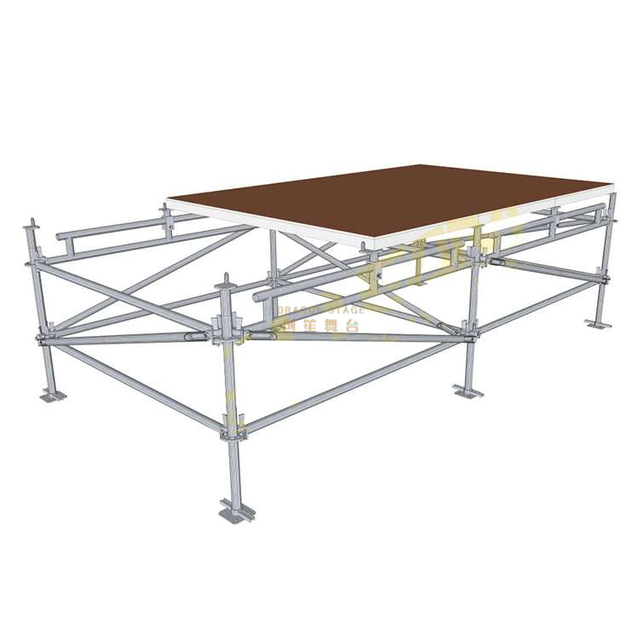
The DragonStage 8.54x6.1m Aluminum Park & Community Event Stage is a 28x20ft brace-supported modular platform built from 35 standard 4x4ft stage decks. The complete configuration includes 18mm anti-slip plywood decking, adjustable support stands, three-side guardrails, a 4-step stair, and black stage skirting, making it suitable for community concerts, park events, ceremonies, public performances, school activities, and temporary outdoor stages.
The Concert Custom Adjustable Portable Stage is the perfect addition to any concert venue. The Concert Custom Adjustable Cheap Portable Stage is a portable stage that is lightweight and easy to set up. It can be adjusted to the height of the performer and is available in two different colors. The Concert Custom Adjustable Cheap Portable Stage is made of durable, lightweight aluminum that will last for years to come. It has a black aluminum top with four black steel legs. The Concert Custom Adjustable Cheap Portable Stage is very easy to set up and is very stable.
Aluminum Mini Modular Stage Panel Flooring Systems 2.44x2.44m 8x8ft Height 0.6-1m with 1 stair.
The DragonStage 2.44x2.44m Adjustable Aluminum Modular Stage is a compact 8x8ft brace-supported event platform built from two standard 4x8ft / 1.22x2.44m wooden-topped stage panels. With an adjustable finished height of 0.6-1.0m, extendable support stands, stage braces, adjustable bases, and stair access components, it is suitable for small performances, DJ events, ceremonies, church activities, presentations, and temporary event staging.
Assemble Portable Stage Movable Aluminum Stage for Outdoor Concert Event 2.44x1.22m 8x4ft with 1 stair.
The DragonStage 2.44x1.22m Portable Aluminum Stage Kit is a compact 8x4ft temporary event platform supplied with one access stair. Designed for small outdoor concerts, DJ performances, speeches, ceremonies, promotions, and temporary event use, the modular stage can also be combined with additional compatible 4x8ft units when a larger platform is required.
The DragonStage 3.8x3.4m Aluminum Arch Truss Gateway is a compact curved entrance structure built from 290×290mm spigot truss with 300×500mm base plates. With overall external dimensions of approximately 3800mm wide × 3400mm high, it is designed for wedding entrances, exhibition gateways, red-carpet areas, event decoration, photo zones, and other temporary event displays.
Base plate only for the U-Frame 50. LED cans and moving heads can be installed freeriding in the room. In combination with the optional wheels the U-Frame Dolly will be an indispensable element on stages and show acts.
U-frame Truss And Dolly, it is custom U torm trusses (660 × 500 × 50mm) for 4 (4 utorm trusses+ top bar+ dolly) and 5 (4 utorm trusses+ top bar+ dolly) Robots in black color.
the dolly is made of 1.2x0.6m aluminum plate, thickness 8mm and 4 casters.
The DragonStage 5.49x1.22m Straight Aluminum Event Stage Ramp provides a direct access route for wedding stages, corporate events, ceremonies, hotel functions, and other temporary platforms. The ramp measures approximately 18ft long × 4ft wide (5.49 × 1.22m) and uses modular 4 × 4ft / 1.22 × 1.22m deck sections with 1m / 3.28ft high guardrails along both sides.
The DragonStage 3.0x1.22m Compact Aluminum Stage Transition Ramp provides a short, direct access route between ground level and temporary event stages. With an overall length of approximately 3.0m / 9.84ftand a width of approximately 1.22m / 4ft, the ramp uses modular aluminum stage components and includes 1m / 3.28ft high guardrailson both sides.
The DragonStage 7.84x1.23m Narrow Straight Aluminum Stage Access Ramp provides a direct route between ground level and an elevated temporary stage for performers, speakers, technicians, event staff, and production crew. Its slim footprint measures approximately 308⅝ × 48⅜ in (7.84 × 1.23m)and uses modular 4 × 4 ft / 1.22 × 1.22mramp deck sections with 1m / 3.28ft high guardrailsalong both sides.
The DragonStage 10.30x1.63m Straight Aluminum Stage Production Loading Ramp provides a direct access route between ground level and temporary event stages. With an overall external size of approximately 405½ × 64⅛ in (10.30 × 1.63m), the system uses standard 4 × 4 ft / 1.22 × 1.22m modular deck sections and 1m / 3.28ft high guardrails along both sides. It is suitable for road cases, AV equipment, production carts, technicians, and general backstage stage access.
The DragonStage 7.32x3.05m Compact Switchback Aluminum Stage Service Ramp provides a continuous access route for AV carts, production trolleys, touring equipment, technicians, and stage crew. Its compact U-shaped footprint measures approximately 24 × 10 ft (7.32 × 3.05m)and uses standard 4 × 4 ft / 1.22 × 1.22mmodular ramp decks with 1m / 3.28ft high guardrailsalong both sides.
The DragonStage 7.40x8.26m L-Shaped Aluminum Backstage Loading Ramp is designed for moving flight cases, lighting cases, audio equipment carts, cable boxes, production trolleys, and event equipment between ground level and temporary stages. The 90-degree layout has an overall footprint of approximately 291⅜ in × 325¼ in (7.40m × 8.26m) and uses standard 4 × 4 ft / 1.22 × 1.22m modular deck sections with 1m / 3.28ft high guardrails along both sides.
The DragonStage 9.82x3.23m Switchback Modular Aluminum Event Stage Ramp is designed for temporary stages requiring a continuous access route for wheelchairs, performers, event staff, carts, and wheeled concert equipment. The compact U-shaped layout measures approximately 386⅝ in × 127¼ in (9.82m × 3.23m) and uses standard 4 × 4 ft / 1.22 × 1.22m modular ramp deck sections with 1m / 3.28ft high guardrails along both sides.
The DragonStage 9.82x8.26m 90-Degree Modular Aluminum Event Stage Ramp is designed for temporary stages that need a continuous access route for wheelchairs, performers, event staff, carts, and wheeled concert equipment. The L-shaped layout measures approximately 386⅝ in × 325¼ in (9.82m × 8.26m)and uses standard 4 × 4 ft / 1.22 × 1.22mmodular deck sections with 1m / 3.28ft high guardrailsalong both sides.
The DragonStage 10.27x3.24m Switchback Modular Aluminum Stage Ramp is a compact U-shaped access system for temporary stages and elevated event platforms. The overall footprint is approximately 404⅜ in × 127½ in (10.27m × 3.24m). It uses standard 4 × 4 ft / 1.22 × 1.22m modular ramp deck sections, with two parallel ramp runs connected by a turning landing and 1m / 3.28ft high guardrails along both sides.