dragon stage
banner_news
You are here: Home » knowledge » Structural Engineering Fundamentals

Structural Engineering Fundamentals for Stage, Truss and Event Structures


Understanding How Event Structures Really Work

Event structures do not become safe simply because they are manufactured from aluminum or assembled according to drawings. Every stage platform, truss roof, lighting tower, scaffold system and temporary event structure relies on fundamental engineering principles that govern how loads move through a structure, how forces are balanced, and how stability is maintained under real operating conditions.


Structural engineering fundamentals provide the framework for understanding why a structure performs safely, why failures occur, and how engineers make design decisions regarding dimensions, materials, connections and load capacities.


This knowledge center organizes the key engineering concepts behind modular event structures and provides a structured learning path for event organizers, production companies, rental providers, engineers and procurement professionals.


Engineering Knowledge Map

Structural engineering for temporary event structures can be divided into six major disciplines:


  1. 1. Load and Force Fundamentals
  2. 2. Structural Stability Principles
  3. 3. Structural Design Logic
  4. 4. Structural Components and Load Paths
  5. 5. Material Behavior in Structures
  6. 6. Structural Failure and Risk Prevention

Together these disciplines explain how stage and truss systems are designed, evaluated and operated safely.

Load and Force Fundamentals

Understanding structural loads is the starting point of all engineering calculations.


Every stage platform, truss roof or support tower must safely transfer loads from equipment, performers, audiences, wind forces and self-weight into the supporting structure and ultimately into the ground.


Key concepts include:

  • Dead Load
  • Live Load
  • Dynamic Load
  • Wind Load
  • Point Load
  • Uniformly Distributed Load
  • Safety Factors
  • Load Combinations

Recommended reading:

Understanding load behavior is essential before selecting structural dimensions, span lengths or support systems.

Portable Aluminum DJ Stage System with Lighting Backdrop Truss.jpg

How to Choose Stage Platform for Events: Size, Load Capacity and Structural Safety Guide

2026 04-15

IntroductionChoosing the right stage platform for events is not only about size and layout — it is about load capacity, structural safety, and material performance.Different events require different stage configurations. A wrong choice may lead to instability, deformation, or even structural failure

Read More
Event Party Portable Aluminium Outdoor Concert Stage Sale 17.08x13.42m.jpg

Best Stage Platform for Concert: Design, Load Capacity and Structural System Guide

2026 04-15

IntroductionConcert stages are very different from standard event stages. They must support high loads, dynamic movement, and complex structural systems.A concert stage is not only a platform — it is part of a complete system that includes:lighting trusssound systemsLED screensroof structuresChoosin

Read More
hanging ladder scaffold (1).jpg

Aluminum Scaffolding Load Capacity: Calculation, Standards and Safety Guide

2026 04-19

What is the Load Capacity of Aluminum Scaffolding?Aluminum scaffolding load capacity typically ranges from 200 kg to over 1000 kg per platform, depending on structural design, material grade, and configuration. Certified systems with proper engineering can safely support higher loads under controlle

Read More
triangle bolt truss (1).jpg

How to Choose Aluminum Truss for Outdoor Events (Safety & Load Guide)

2026 03-27

What is the best aluminum truss for outdoor events?The best aluminum truss for outdoor events is typically a spigot truss system (400mm–520mm) combined with a roof truss structure, designed to handle wind loads, heavy equipment, and fast installation. It should meet load capacity requirements, inclu

Read More
portable scaffolding (1).jpg

Aluminum Scaffolding System: Structure, Safety, Load Capacity and Application Guide

2026 04-19

What is Aluminum Scaffolding?Aluminum scaffolding is a modular temporary access system made of high-strength aluminum alloy, designed for safe working at height. It is lightweight, corrosion-resistant, and easy to assemble, making it ideal for construction, maintenance, events, and indoor applicatio

Read More

Structural Stability Principles

A structure may have sufficient load capacity and still become unstable.


Structural stability focuses on maintaining equilibrium under vertical and lateral forces while preventing excessive movement, deformation or collapse.


Important topics include:

  • Compression and Tension
  • Bracing Systems
  • Structural Buckling
  • Center of Gravity
  • Lateral Stability
  • Wind Resistance
  • Dynamic Response

Recommended reading:

Stability engineering is especially critical for outdoor structures exposed to wind loading and uneven ground conditions.

TUV testing on aluminum quick stage.jpg

Stage Load Calculation Explained: How Material Selection Affects Structural Safety

IntroductionIn stage engineering, many people focus on formulas, but fewer understand what actually controls the result.Stage load calculation is not only about numbers — it is about material behavior.The same structure, with the same dimensions, can produce different safety outcomes depending on th

Read More
TUV testing on aluminum quick stage.jpg

Stage Platform Load Calculation: Methods, Factors and Structural Safety Principles

IntroductionStage platform load calculation is a fundamental part of structural design in event and temporary systems.However, many calculations are simplified into formulas without understanding what actually affects the result.In reality, load capacity depends on:material propertiesstructural desi

Read More
hanging ladder scaffold (1).jpg

Aluminum Scaffolding Load Capacity: Calculation, Standards and Safety Guide

What is the Load Capacity of Aluminum Scaffolding?Aluminum scaffolding load capacity typically ranges from 200 kg to over 1000 kg per platform, depending on structural design, material grade, and configuration. Certified systems with proper engineering can safely support higher loads under controlle

Read More
Key Components of Modular Truss Systems.jpg

Key Components of Modular Truss Systems and Their Structural Functions

System OverviewPurpose of a Modular Truss Stage SystemA modular truss stage system is a temporary yet load-bearing structure widely used for outdoor events and concerts that require a roofing system. Such systems are typically applied in medium-scale applications where controlled span and height are

Read More
portable scaffolding (1).jpg

Aluminum Scaffolding System: Structure, Safety, Load Capacity and Application Guide

What is Aluminum Scaffolding?Aluminum scaffolding is a modular temporary access system made of high-strength aluminum alloy, designed for safe working at height. It is lightweight, corrosion-resistant, and easy to assemble, making it ideal for construction, maintenance, events, and indoor applicatio

Read More

Structural Design Logic

Engineering design is the process of transforming performance requirements into structural solutions.


Design decisions are influenced by:

  • Span requirements
  • Height requirements
  • Equipment loads
  • Audience interaction
  • Environmental conditions
  • Installation efficiency
  • Transportation constraints
  • Safety regulations

Design engineers evaluate these variables to determine the most suitable structural configuration.


Recommended reading:

Engineering design is not merely selecting products; it is selecting structural behavior.

Structural Components and Load Paths

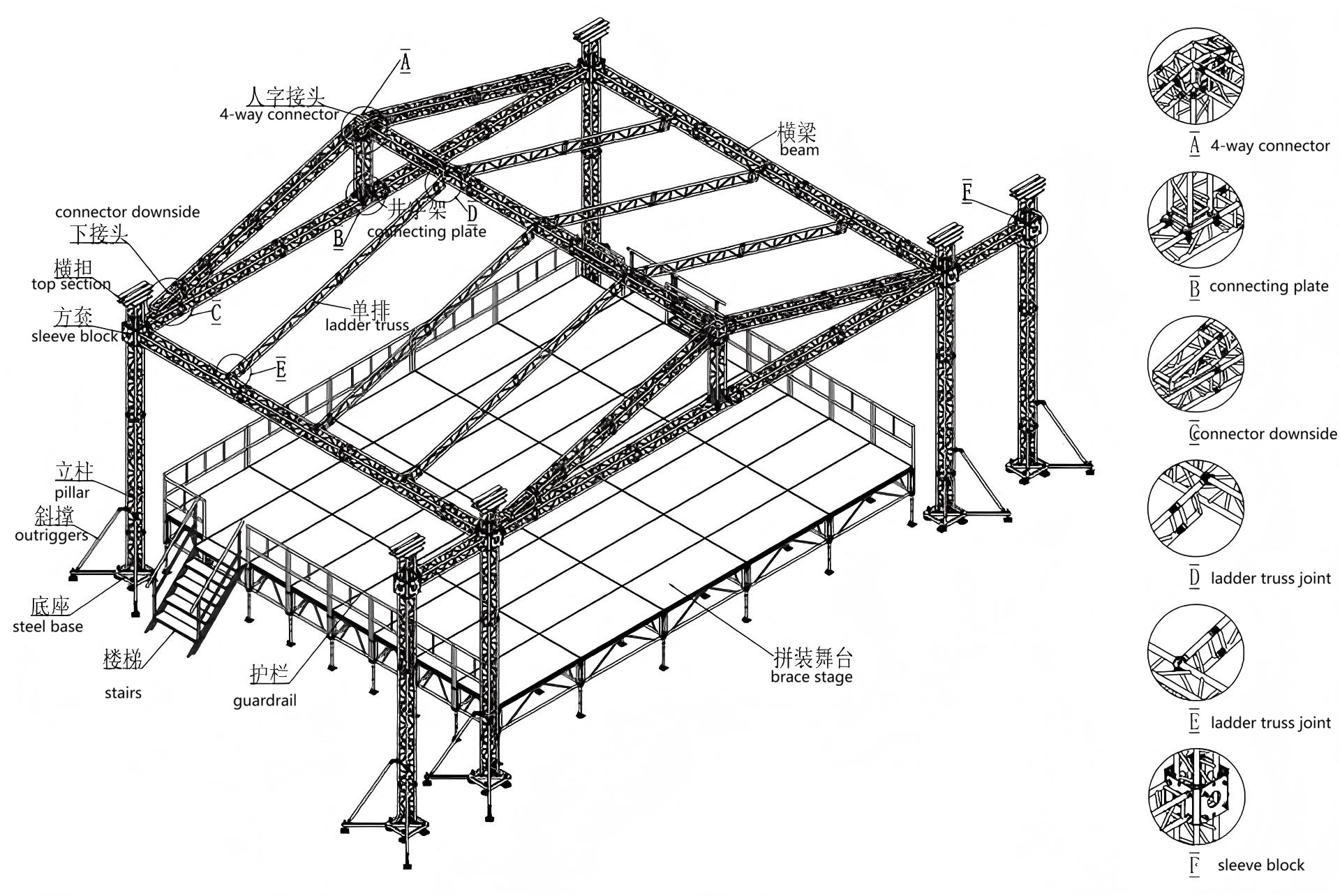
Every structure transfers loads through a defined path.


Understanding load paths helps engineers identify critical components, connection points and potential failure mechanisms.


A typical load path follows:

Equipment or Occupancy Load

Deck Surface

Beams and Trusses

Support Columns

Base Plates

Ground Reaction


When any part of the load path becomes overloaded or improperly assembled, structural performance may be compromised.


Recommended reading:

Load path analysis is one of the most important concepts in modern structural engineering.

What Is LED for Stage Lighting (2).png

Understanding Lighting Accessories

Stage lighting fixtures are complex systems consisting of multiple components, broadly categorized into three major systems: 1. Electronic System, 2. Mechanical System, and 3. Optical System.Electronic System:The electronic system comprises components such as control circuit boards, switch power sup

Read More
Key Components of Modular Truss Systems.jpg

Key Components of Modular Truss Systems and Their Structural Functions

System OverviewPurpose of a Modular Truss Stage SystemA modular truss stage system is a temporary yet load-bearing structure widely used for outdoor events and concerts that require a roofing system. Such systems are typically applied in medium-scale applications where controlled span and height are

Read More
linear lights usage (1).jpg

What Is Stage Lighting Design

Stage lighting is the lighting used to illuminate a stage, and it is a valuable tool for all types of events. In addition, stage lighting design is used to illuminate the stage in conformity with the event. It's a technique for drawing attention to people, stage backgrounds and equipment, and more a

Read More
Event Party Portable Aluminium Outdoor Concert Stage Sale 17.08x13.42m.jpg

Best Stage Platform for Concert: Design, Load Capacity and Structural System Guide

IntroductionConcert stages are very different from standard event stages. They must support high loads, dynamic movement, and complex structural systems.A concert stage is not only a platform — it is part of a complete system that includes:lighting trusssound systemsLED screensroof structuresChoosin

Read More
Small Assembly Adjustable Height Wedding Stage 6.1x3.66m Height 0.6-1m with 2 Stairs.jpg

Best Stage Platform for Wedding: Design, Size, Material and Setup Guide

IntroductionChoosing the right stage platform for a wedding is not only about appearance — it is about stability, safety, and overall event experience.A wedding stage must:look elegantbe structurally safefit the venue layoutsupport equipment and movementThe wrong stage choice can affect both visual

Read More

Material Behavior in Structures

Structural performance depends heavily on material properties.


Different materials respond differently to compression, tension, bending, fatigue and environmental exposure.


Important considerations include:

  • Yield Strength
  • Elastic Modulus
  • Fatigue Resistance
  • Corrosion Resistance
  • Weldability
  • Weight-to-Strength Ratio

Recommended reading:

Material selection directly affects safety margins, transportation efficiency and long-term durability.

welding.jpg

6061-T6 vs 6082-T6 Aluminum: Mechanical Properties and Structural Differences

IntroductionIn stage systems, truss structures, and load-bearing frames, material selection is not just about cost — it directly affects safety and structural performance.Among aluminum alloys, 6061-T6 and 6082-T6 are two of the most commonly used materials in event and structural applications.To be

Read More
Aluminum Roof Stage Lighting Truss System.jpg

6061-T6 vs 6082-T6 Aluminum: Standards, Mechanical Requirements and Structural Compliance

IntroductionIn stage systems, truss structures, and load-bearing frames, material selection is not only a technical decision — it is a compliance requirement.Aluminum alloys such as 6061-T6 and 6082-T6 are widely used in structural applications, but their use must follow industry standards, not assu

Read More
no photo

Material Selection Risks in Stage Structures: 6061-T6 vs 6082-T6 Explained

IntroductionIn stage systems, truss structures, and temporary load-bearing frames, most failures are not caused by extreme loads, but by incorrect assumptions about materials.Aluminum alloys such as 6061-T6 and 6082-T6 are widely used, but they behave differently under load, especially when span, co

Read More
14x10m Durable Layer Stage Steel Portable Stage.jpg

Steel vs 6061-T6 Aluminum: Strength, Weight and Structural Differences

IntroductionIn stage engineering and temporary structures, choosing between steel and 6061-T6 aluminum is not just about strength — it is about how the structure behaves under load.Many decisions are made based on assumptions such as “steel is stronger” or “aluminum is lighter”.But in real projects,

Read More
Layher Stage Guardrail for Edge Protection.jpg

Steel vs 6082-T6 Aluminum: Strength, Weight and Structural Replacement Analysis

IntroductionIn structural systems, the comparison between steel and 6082-T6 aluminum is not only about strength — it is about whether one material can replace the other.Unlike general-purpose alloys, 6082-T6 aluminum is a high-strength structural material, often used in load-bearing systems where pe

Read More

Structural Failure and Risk Prevention

Engineering safety is not achieved by avoiding loads.


Engineering safety is achieved by understanding failure mechanisms and controlling risk.


Common structural failures include:

  • Overloading
  • Improper Assembly
  • Insufficient Bracing
  • Foundation Settlement
  • Wind-Induced Failure
  • Connection Failure
  • Fatigue Damage
  • Material Defects

Recommended reading:

Preventive engineering practices are significantly more effective than corrective actions after structural issues occur.

Structural Failure and Risk Prevention

Engineering safety is not achieved by avoiding loads.


Engineering safety is achieved by understanding failure mechanisms and controlling risk.


Common structural failures include:

  • Overloading
  • Improper Assembly
  • Insufficient Bracing
  • Foundation Settlement
  • Wind-Induced Failure
  • Connection Failure
  • Fatigue Damage
  • Material Defects

Recommended reading:

Preventive engineering practices are significantly more effective than corrective actions after structural issues occur.

Related Engineering Knowledge Centers

To explore more specialized engineering topics, visit:


  • [Installation Methodology for Modular Stage, Truss and Scaffold Systems]
  • [Modular System Logic for Stage, Truss and Scaffold Structures]
  • [Safety Standards and Engineering Constraints for Temporary Structures]
  • [Engineering Solutions for Concerts, Exhibitions and Event Productions]

These resources expand on the engineering principles presented in this structural engineering fundamentals guide and provide practical applications for real-world event projects.

Conclusion

Structural engineering fundamentals form the foundation of every successful stage, truss, scaffolding and temporary event structure.


Whether evaluating load capacity, selecting materials, designing support systems or preventing failures, engineers rely on a common set of principles that govern structural behavior.


By understanding load transfer, stability, design logic, material performance and risk management, project teams can make safer and more informed decisions throughout the lifecycle of an event structure.

Professional Techincal Team since 2008

Browse by Category

Need a Custom Stage or Truss Solution?


Whether you are planning a concert, exhibition, outdoor event or rental project, we can provide professional design support, structural recommendations and complete product solutions.

Tell us your requirements and our team will help you find the most suitable configuration.

FOSHAN DRAGON STAGE 

No.7,Xiaxi Industrial Area,Heshun,Nanhai District,Foshan,528241,Guangdong,China.

 +86  136 3132 8997

QUICK LINKS

PRODUCT LIST

Copyright © 2020 FOSHAN DRAGON STAGE EQUIPMENT CO.,LTD  备案号:粤ICP备2020113505号