Introduction
In stage systems, truss structures, and temporary load-bearing frames, most failures are not caused by extreme loads, but by incorrect assumptions about materials.
Aluminum alloys such as 6061-T6 and 6082-T6 are widely used, but they behave differently under load, especially when span, connection conditions, and structural design change.
Before making any design decision, it is essential to understand how material properties influence safety through stage load calculation.
Note: In structural applications, mechanical properties must be based on aluminum extrusion profiles, not sheet or plate data.
This article focuses on real safety risks, not just material data.
Why Material Choice Directly Affects Safety
Material selection defines the upper limit of structural safety.
Yield strength → determines when permanent deformation begins
Tensile strength → defines failure limit
Elongation → controls how the structure absorbs stress
If these properties are misunderstood, the structure may:
This is especially critical in temporary structures such as those discussed in how much weight a stage can hold.
Risk of Using the Wrong Aluminum Alloy
The difference between 6061-T6 and 6082-T6 directly affects safety.
Practical Risk
Using 6061-T6 in a structure that requires higher strength can result in:
This is often seen in improperly designed roof truss systems.
Material Behavior Risks (Key Engineering Reality)
One of the most misunderstood issues is:
Material performance is influenced by structural conditions, not just thickness alone
Observed behavior in extrusion profiles:
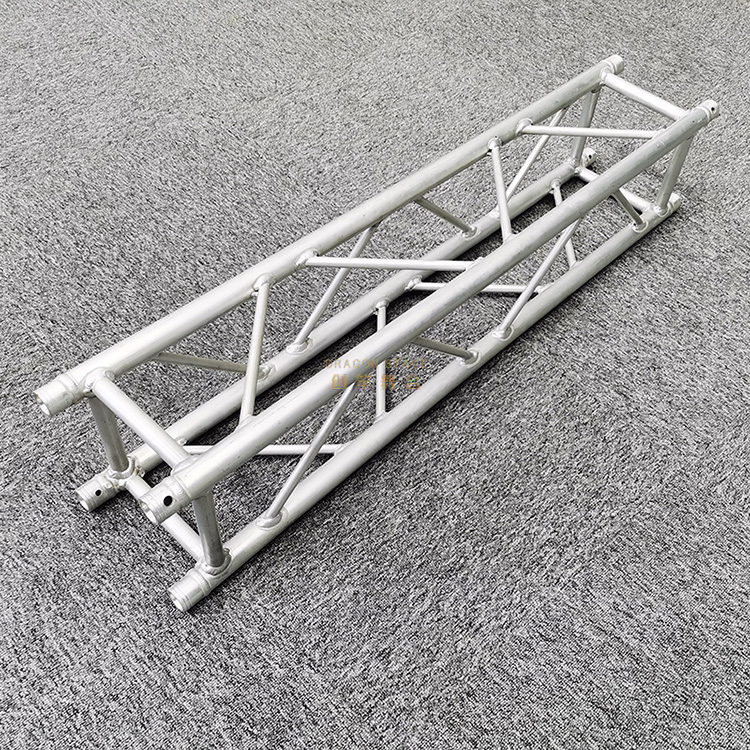
structural stiffness depends on section design
deformation depends on load distribution
connection quality affects failure risk
Safety Implication
Ignoring this leads to incorrect assumptions in stage load calculation guide.
Real Safety Implications in Stage and Truss Systems
Material misuse often appears in:
→ Risk: local deformation in stage platform systems
Event Truss Systems
Using lower-strength material in medium-span structures
Not considering dynamic loads (lighting, movement)
→ Risk: progressive deformation in event truss systems
Roof Truss Systems
→ Risk: structural failure in roof truss systems
Common Safety Mistakes
From real project observations:
Assuming all aluminum alloys behave the same
Using sheet data instead of extrusion data
Replacing 6082 with 6061 without recalculation
Skipping proper stage load calculation
Over-relying on experience instead of engineering verification
These mistakes do not always fail immediately — which makes them more dangerous.
How to Reduce Structural Risk
Safety is not about choosing the strongest material, but about choosing the correct material for the correct condition.
Key Actions
Engineering Perspective
From an engineering point of view:
6061-T6 and 6082-T6 are both safe when used correctly — and unsafe when misused.
Conclusion
Most structural risks in stage systems come from wrong assumptions, not extreme conditions.
The real difference is not only strength, but how materials behave within the structure.
Safety comes from:
correct understanding
correct selection
correct calculation
FAQ
Is 6061-T6 unsafe for stage structures?
No. It is safe when used within its design limits, especially in stage platform systems.
Why is 6082-T6 preferred for large structures?
Because higher yield strength improves safety margin in roof truss systems.
What is the biggest safety risk in aluminum structures?
Incorrect assumptions and lack of proper stage load calculation.
Does thickness affect safety?
Yes, but in extrusion structures, safety depends more on section design and load distribution than thickness alone.
How to ensure structural safety in stage systems?
By combining correct material selection with verified stage load calculation.
Recommended Technical Reading