A black steel Ringlock standard and a black aluminum truss can look surprisingly similar from a distance.
Both are metal.
Both can receive electrostatic powder coating.
Both can come out of the workshop with a black finished surface.
So a reasonable question is:
If the final process is powder coating, why don't steel and aluminum components simply go through the same treatment line?
The answer becomes clearer when we stop looking at the final color and look at the material underneath it.
In the processes currently used by our coating workshop, steel Ringlock components and aluminum truss or stage components follow different preparation routes before the final powder coating is applied.
The visible finish may be similar.
The surface underneath is not.
The Main Difference at a Glance
According to the current process documentation provided by our coating workshop, the two routes can be summarized as follows:
Process Stage
Steel Ringlock / Layher-Type Components
Aluminum Truss / Stage Components
Initial surface preparation
Sandblasting
Sandblasting / surface cleaning
Removal of oil and contamination
Yes
Yes, as part of surface cleaning
Acid pickling
Included in current process
Not listed in current process
Surface conditioning
Included
Not listed
Phosphating
Included
Not listed
E-coating
Included
Not listed
Local grinding
100-grit where necessary
100-grit where necessary
High-pressure air cleaning
Yes
Yes
Drying
Current oven setting: 210°C
Current oven setting: 210°C
Electrostatic powder coating
Yes
Yes
Powder curing
Current oven setting: 220°C
Current oven setting: 220°C
Custom color
According to available powder coating options
According to available powder coating options
At first glance, the last part looks almost the same:
dry → powder coat → cure
The major difference is what happens before that.
That is the central point of this comparison.
1. Powder Coating Is a Finish, Not the Entire Surface-Treatment Process
One of the easiest mistakes when discussing powder coating is to use the words “powder coating” to describe everything that happens to the component.
In manufacturing, that hides too much.
The electrostatic application of powder is only one stage.
Before reaching that point, the workshop has to deal with the actual condition of the base material:
oil;
oxides;
rust where applicable;
welding residue;
dust;
fabrication contamination;
and local surface irregularities.
The treatment route therefore starts with a different question:
What material are we preparing, and what condition is its surface in?
Only after that question has been dealt with does the visible powder-coated finish become relevant.
This is why two components can eventually receive the same black powder while following different preparation routes.
2. Steel Ringlock: The Current Process Uses a Longer Pretreatment Route
For the steel Ringlock and Layher-type components processed through our current coating workshop, the documented route includes:
This route deals with the surface condition of fabricated steel components before the final powder layer is applied.
The initial sandblasting is used to remove materials such as:
rust;
welding residue;
and other surface impurities.
The following wet pretreatment removes oil, oxides, dust and contamination and includes phosphating.
The steel components then receive another treatment that does not appear in the aluminum process documentation:
electrophoretic coating, or e-coating.
According to our coating workshop's current process specification, the electrophoretic coating can also enter approximately 20–30 cm into the tube ends.
Only after this treatment is dried and the surface inspected does the component proceed to the final powder-coating stage.
For the complete step-by-step process, see our detailed guide to Steel Ringlock / Layher-Type Structure Powder Coating Process.
Internal link note: Link this text to the Steel Ringlock powder coating article after publication.
3. Aluminum Components Follow a Different Preparation Route
For the aluminum components documented by the same coating workshop, the process is different.
The workshop documentation specifically mentions removing:
oil;
surface oxides;
dust;
and other impurities.
It does not list the steel process's:
acid-pickling sequence;
phosphating sequence;
or electrophoretic coating stage.
That distinction matters.
We should not take a process designed around one base material and automatically assume that every step belongs in the other material's process.
For the detailed aluminum route, see Powder Coating Process for Aluminum Truss and Stage Components.
Internal link note: Link this text to the aluminum powder coating article after publication.
4. The Same Final Color Does Not Mean the Same Manufacturing Process
Imagine two finished components sitting next to each other:
Component A: black powder-coated steel Ringlock standard Component B: black powder-coated aluminum truss component
To a customer looking at the finished products, the obvious common feature is:
both are black.
From the coating workshop's point of view, however, “black” is almost the end of the story.
Before that final color is applied, the workshop has been dealing with two different base materials and two different documented preparation routes.
This gives us a useful manufacturing principle:
Do not judge a surface-treatment process only by the finish you can see.
The appearance tells you what is on the outside.
It does not tell you everything that happened underneath.
This principle applies beyond one particular Ringlock standard or aluminum truss. Material, component construction and manufacturing route need to be considered together.
More information about the materials and components used in our event structures can be found in Material & Component Knowledge.
5. Why Does the Steel Process Include E-Coating While the Aluminum Process Does Not?
Based on the process documentation supplied by our current coating workshop, e-coating is part of the steel Ringlock treatment route and is used as part of its anti-rust treatment before final powder coating.
The aluminum process documentation does not include this step.
That is the factual boundary of the information we currently have.
It would be easy to go further and make broad statements such as:
“All steel products require e-coating before powder coating.”
or:
“Aluminum never requires this type of pretreatment.”
But our workshop documents do not establish either universal rule.
What they establish is narrower and more useful:
For these current production routes, our steel Ringlock components and aluminum components are prepared differently before powder coating.
The process should therefore be understood in relation to the base material and the coating system actually being used, rather than assuming that “powder coated” means one universal recipe.
6. What Is Actually the Same?
The two routes are not completely different.
Once the respective preparation stages are completed, they begin to converge.
In the current workshop processes, both aluminum and steel components undergo:
Surface inspection and cleaning
Local areas can be treated with 100-grit abrasive where necessary, followed by wiping and high-pressure air cleaning.
Drying
The current workshop documentation specifies an oven setting of:
210°C
The purpose immediately before powder coating differs according to the preceding process: for the documented steel route, this follows e-coating; for the aluminum route, the documentation describes drying surface moisture.
Electrostatic powder application
Both materials then receive the required powder-coated finish.
Final curing
The current workshop documentation specifies:
220°C
for the final powder-curing stage.
This is a useful example of how two manufacturing routes can be different at the beginning but share later production stages.
7. Color Selection Is Separate from Material Preparation
Another common source of confusion is mixing color selection with surface preparation.
Suppose a customer requests:
RAL 9005 black.
The required color tells the coating workshop what visible finish is wanted.
It does not automatically determine how the underlying steel or aluminum should be prepared.
These are two separate questions:
Question 1: What material are we coating? This affects the preparation route.
Question 2: What final color does the customer require? This determines the selected powder coating color.
For customized products, customers should therefore provide an exact RAL color code where a specific finish is required.
Screen-displayed colors should only be treated as a reference. Where precise color matching matters, the requirement should be confirmed before production.
8. What Should a Buyer Actually Ask About Powder Coating?
Instead of asking only:
“Is this powder coated?”
a more useful manufacturing question is:
“How is the material prepared before powder coating?”
That question reveals much more.
For example, with the two processes documented here, it leads to questions such as:
Is the component steel or aluminum?
How is contamination removed?
Is sandblasting used?
What pretreatment steps are used?
Does the steel process include phosphating?
Does it include e-coating?
How is the component inspected before powder application?
What color reference is being used?
These questions help separate a visible finish description from an actual manufacturing process description.
This distinction is particularly useful when evaluating customized stage, truss and scaffold components, because surface finish is only one part of the finished product.
Connection methods, material selection and component interfaces are separate issues. These are discussed further in our Connection Material System.
9. Does a More Complicated Process Automatically Mean Better Performance?
Not necessarily.
A process containing more steps should not automatically be described as “better” without defining:
better for what?
For example, our current steel process contains more documented pretreatment stages than the aluminum process.
That does not mean we should conclude:
“Steel powder coating is better than aluminum powder coating.”
They are different materials following different treatment routes.
Likewise, the existence of sandblasting, phosphating, e-coating and powder coating does not by itself establish a verified:
corrosion category;
salt-spray duration;
coating thickness;
outdoor service life;
or compliance classification.
Those are performance claims.
They require corresponding testing, specifications or inspection records.
Manufacturing-process evidence tells us what was done.
Performance evidence tells us what verified result that process achieved under defined conditions.
The two should not be confused.
10. A Simple Way to Understand the Difference
The easiest way to remember the whole subject is this:
Powder color answers: “What should the finished component look like?”
Surface preparation answers: “What needs to happen to this material before we put that finish on it?”
That is why steel Ringlock and aluminum truss can both finish as black powder-coated products without following exactly the same route.
In the processes documented by our current coating workshop:
They do not necessarily start from the same place.
FAQ
Is powder coating the same process for steel and aluminum?
No. Powder application itself may be similar, but the surface-preparation route can differ. In our current workshop documentation, steel Ringlock components undergo phosphating and e-coating before powder coating, while the documented aluminum process follows a different surface-preparation route without those listed stages.
Why is surface preparation important before powder coating?
Because the powder is applied over the prepared base material. Oil, oxides, rust where applicable, fabrication residue, dust and local surface irregularities need to be addressed before the final coating process.
Does steel always need e-coating before powder coating?
Our current Ringlock coating process includes e-coating, but the available process documentation does not establish that e-coating is universally required for every powder-coated steel product.
Can steel and aluminum use the same RAL powder color?
They can be produced in the same requested RAL color where that powder option is available. However, using the same final color does not mean that the underlying surface-preparation process is identical.
Does this process prove how long the coating will last outdoors?
No. The documented manufacturing route does not by itself establish a specific outdoor lifetime, salt-spray duration or corrosion classification. Those claims require appropriate test or specification data.
Choosing a Surface Finish for a Custom Product
When requesting a customized powder-coated truss, stage component or steel Ringlock structure, it is useful to provide:
and drawings or reference photos where customization is involved.
This allows the product configuration and surface-finish requirement to be considered together rather than treating powder coating as an isolated color choice.
For steel Ringlock structures, you can also review our Ringlock Structure System to understand the wider component system.
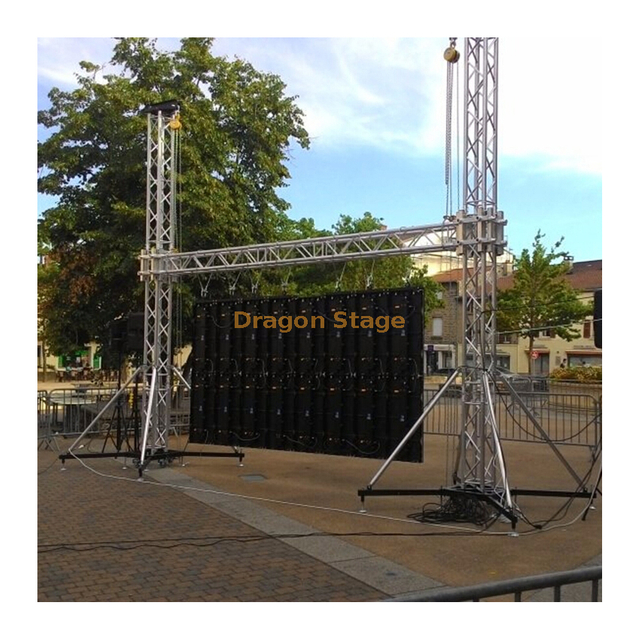
The DragonStage 6x3x3m Aluminum Ground Support Lighting Truss System is a compact rectangular truss structure designed for stage lighting, DJ events, exhibitions, ceremonies, corporate events, and other temporary productions. The system provides a 6m wide × 3m deep × 3m high overhead lighting grid supported by four vertical towers.
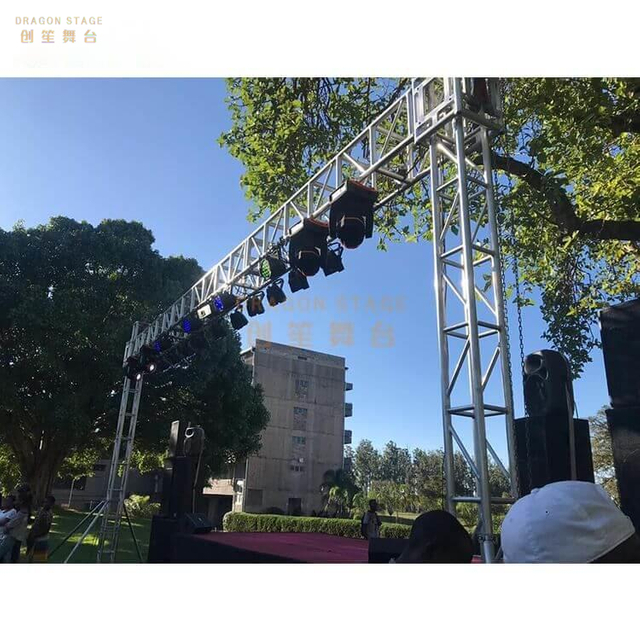
this is a most welcome non roof Aluminum Outdoor Stage Lights Event Truss
total net sizes are 9x8x5m
The DragonStage 9x8x5m Aluminum Non-Roof Lighting Truss System is a modular ground-support structure for concerts, lighting productions, ceremonies, exhibitions, and temporary events. The main frame measures approximately 9m wide × 8m deep × 5m high and includes two 2m side wings, providing additional positions for sound, lighting, LED, or other event equipment according to the final project configuration.
Outdoor Aluminum Portable Small Lighting Truss 30x30x16.4ft 2 Wings 6.56ft
9x9x5m, wing width 2m
The DragonStage 9x9x5m Aluminum A-Frame Lighting Roof Truss System is a modular outdoor event structure for concerts, festivals, ceremonies, and temporary live productions. The main structure measures approximately 9m wide × 9m deep × 5m high, with two 2m-wide side wings for auxiliary sound, lighting, LED, or event equipment according to the final project layout.
Maximize your festival production with this 18m x 8m aluminum lighting roof truss system. Standing 8m high, it features integrated 4m LED screen wings and 3m sound wings for professional line array suspension. Engineered for major outdoor concerts and professional events requiring a massive performance area and heavy-duty structural load capacity.
Explore our professional 8m x 6m aluminum peak roof stage truss system, engineered for outdoor concerts and events. This robust, TUV-certified structure stands 5m high and includes dual 2m wide integrated speaker wings for optimal sound system suspension. Durable and easy to assemble for high-impact performances.
The DragonStage 8x6x3m Aluminum Lighting Truss System is a freestanding rectangular lighting grid designed for concerts, exhibitions, ceremonies, corporate events, and temporary productions. The system provides an 8m wide × 6m deep × 3m highoverhead truss area supported by four ground-support towers, creating multiple positions for stage lighting and event equipment
Dragonstage Aluminum Spigot 300x300mm / 289x289mm Square Box 6 Ways Corner Truss Cube Connector is an aluminum spigot with a 300x300mm square box with 6 ways corner truss cube connector. This aluminum spigot is perfect for hanging lights, air conditioning, and other things. The dimensions of the spigot are 300x300mm square box with 6 ways corner truss cube connector.
This box can be used to create a stable structure for your display or party. You can use this box to create a corner truss cube. It can be used for exhibitions, retail, and party displays. The box has a 400x400mm or 389x389mm square opening. The box has six ways to connect.
Our 290mm Aluminum Square Spigot Truss with 50x3mm main tubing is a heavy-duty solution for professional rigging. Utilizing a modular system logic, this versatile series is ideal for concert and event stages, offering exceptional load-bearing stability and rapid assembly for any production environment.
Aluminum Spigot Truss Sleeve Block for 290*290mm 400*400mm 390*390mmSpigot Truss System Tower Lifting Blocks
500x600mm / 520x760mm / 600x760mm
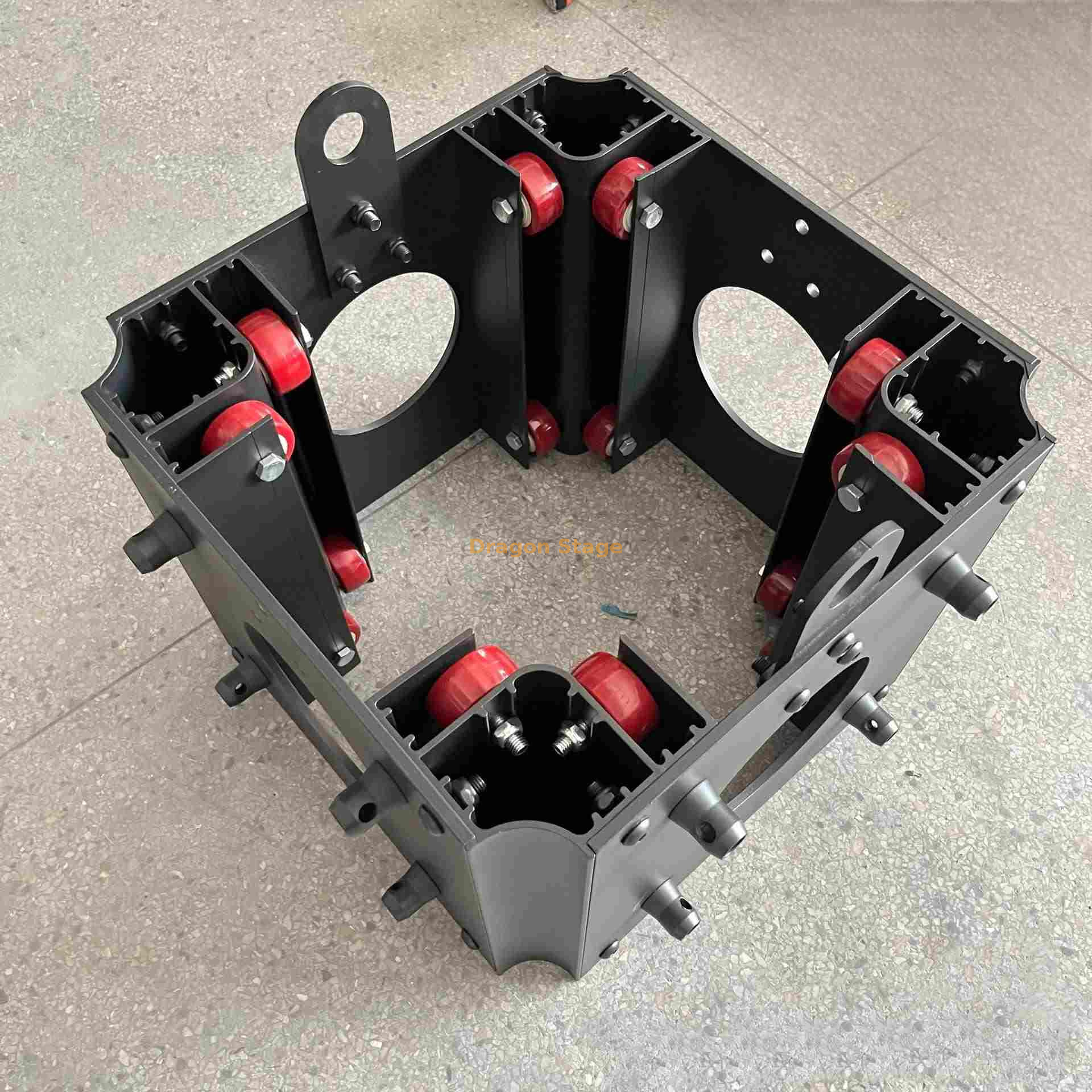
The DragonStage Aluminum Spigot Truss Sleeve Block is a tower connection and lifting component for modular ground-support truss systems. It is available for compatible 290×290mm, 390×390mm, and 400×400mm spigot truss configurations, with sleeve block size options including 500×600mm, 520×760mm, and 600×760mm. It is used to connect horizontal beam trusses to vertical tower trusses in temporary roof, lighting, LED, and event truss systems.
the outside multi-functional connecting plate for F34 290mm truss and F44 400mm truss
The DragonStage F44 400x400mm Sleeve Block is a multi-face connection component for ground-support truss towers. This version is configured for compatible F34 approx. 290mm square truss and F44 400mm square truss, providing four connection sides for building beam-to-tower junctions in temporary stage, lighting, LED, and event truss systems.
This 4m diameter round aluminum mobile stage with roof is a compact modular performance system designed for weddings, ceremonies, concerts, and outdoor events. It combines a round aluminum stage platform, four truss-supported roof towers, a waterproof black canopy, and an aluminum entrance stair in one portable set for repeated assembly and disassembly.
The DragonStage 3x3m Aluminum Goal Post Truss is a freestanding modular truss structure designed for sports events, entrances, branding, banners, lighting, and temporary event displays. The structure measures 3m wide × 3m high, with a 2.5m deep base frame extending along the ground on both sides.
The DragonStage 4x4m Ringlock FOH Platform / VIP Viewing Platform is a modular elevated structure for front-of-house control use or temporary VIP viewing use. The main platform is 4m wide and 4m deep, with a 1.5m platform height and a total structure height of 4.5m. A side 2m small platform with stair access makes entry safer and more practical for event operations
The DragonStage 12x4x8m Ringlock LED Screen and Line Array Hanging Structure is a double-row temporary event support system designed for hanging both LED screens and line array speakers. The overall structure is 12m wide, 4m deep, and 8m high, with a front row height of 8m and a rear row height of 4m. The top is equipped with 6 top section trusses for LED screen and speaker suspension.
The DragonStage 14x4x8m Ringlock LED Screen Hanging Structure is a temporary concert and event LED support system built with a double-row Ringlock frame. The front row reaches 8m high, while the rear row is 2m high, creating an overall structure approximately 14m wide × 4m deep × 8m high. The upper structure includes 4 top section trusses and a 14m-long aluminum truss beam for hanging the LED screen.
DragonStage 16x2x8m ringlock background structure combined with a 12.2x7.32m aluminum stage and a 14x10x6m aluminum bolt truss lighting roof. The system includes a 4m diameter circular truss, 1.22x1.22m stage decks, and 2 stage stairs, making it suitable for concerts, ceremonies, brand events, and temporary performance setups.
The DragonStage 6x1.5x4m Aluminum Truss Entrance Gantry is a temporary entrance and signage structure for sports competitions, festivals, exhibitions, and public events. The complete structure measures approximately 6m wide × 1.5m deep × 4m high and is assembled from 200mm aluminum spigot truss and cube joints. The upper and side truss sections provide practical positions for entrance signs, sponsor branding, event names, start/finish identification, and directional graphics.
DragonStage 4-tower ringlock line array hanging system with 1 main 10m tower and 3 auxiliary 6m towers. The main tower is designed for line array suspension, while the lower platform areas provide 3 ballast positions and 3 working platforms for temporary concert and event sound support.
DragonStage 2x2x11m Ringlock line array hanging system for temporary concert and event sound applications. The structure is 2m wide, 2m deep, and 11m high, with 2 bottom working platforms, 2 ballast positions, and 1 steel heavy-duty brace + top section for line array suspension.
The DragonStage 8x4x8m Double-Row Ringlock Line Array Hanging System is a temporary concert sound-support structure with an overall footprint of 8m wide × 4m deep. The front Ringlock row reaches 8m high, while the rear support row is 6m high. At the top, 4 steel heavy-duty brace + top section suspension sets provide multiple hanging positions for line array speaker systems.
DragonStage 2x2x8m Ringlock Line Array Hanging Tower is a compact temporary speaker support structure for concerts and outdoor events. It uses a modular ringlock frame, includes 1 working platform, 1 ballast at the base, and a top hanging section made with 2 steel heavy duty braces plus a top section. A waterproof roof is installed above the hanging area for basic weather protection.
The DragonStage 2x2x10m Ringlock Line Array Hanging Tower is a compact temporary sound-support structure for concerts and outdoor events. It uses a ringlock main frame, includes 1 working platform, 4 ballast units at the base, and a top hanging assembly made with 2 steel heavy duty braces plus a top section. The tower also includes a waterproof roofing cover above the hanging area.
The DragonStage 2x2x14m Ringlock Line Array Hanging Tower is a tall temporary sound-support structure for concerts and live events. The tower measures 2m wide × 2m deep × 14m high, with 4 working-platform levels, 4 ballast units at the base, and a top suspension assembly consisting of 2 steel heavy-duty braces plus a top section for line array hanging. A waterproof roof cover is installed above the top area to provide weather protection for the upper equipment zone.
The DragonStage Ringlock Line Array and LED Screen Suspension Tower is a compact temporary event structure built with a 2m wide × 2m deep × 10m high ringlock system. It includes 4 working platforms, 4 ballast blocks at the base, a top suspension section with 2 steel heavy duty braces for line array hanging, and an extended side projection for LED screen suspension.
The DragonStage Ringlock LED Background Structure with Ringlock Stage is a complete temporary event system combining a 12m wide × 2m deep × 10m high LED background structure with an 8m wide × 4m deep × 2m high Ringlock stage and 2 access stairs. It is suitable for concerts, festivals, ceremonies, and temporary stage productions that need both a tall LED background support structure and an elevated performance platform.
The DragonStage 2x4x8m Ringlock Line Array Hanging System is a temporary sound-support structure made from two connected ringlock towers. The overall structure is 2m wide, 4m deep, and 8m high at the highest point. The front tower is 8m high, the rear tower is 6m high. At the bottom, the system includes 1 ballast position and 1 working platform. At the top, two steel heavy-duty braces plus a top section form the main hanging structure for the line array.
The DragonStage Twin Ringlock LED Hanging Tower System is a temporary LED support structure made of two identical ringlock load-bearing towers connected by a 6m long 400mm aluminum truss for hanging an LED display screen. Each tower has a total footprint of 4m wide × 4m deep, with a front support section 4m wide × 2m deep × 8m high and a rear support section 4m wide × 2m deep × 2m high. Each tower base is arranged with 4 ballast units to form a practical temporary support solution for concerts, events, and outdoor screen installations.
The DragonStage 2x4x8m Ringlock LED Hanging System is a temporary ringlock-based LED support structure built from two connected towers. The main tower is 8m high, the auxiliary tower is 4m high, and the overall footprint is 2m wide × 4m deep. The second tower includes a ballast area at the bottom, while the top uses a projecting cantilever beam with 400mm aluminum truss for LED screen hanging. This design is suitable for concert, event, and temporary LED display applications.
The DragonStage 2x4x8m Ringlock Line Array Hanging Tower System is a temporary event sound support structure made from two connected ringlock towers. The main tower is 8m high and the auxiliary tower is 4m high. The main tower includes a working platform at the bottom, while the auxiliary tower supports a ballast area. A steel top beam is installed above the main tower for hanging the line array speaker system.
The DragonStage 4x2x8m Ringlock Line Array Support System is a hybrid ringlock + aluminum truss structure for temporary concert and event audio support. It combines a top aluminum truss beam for line array hanging, pallet working platforms, a water-ballast support platform, a side speaker bracket with aluminum truss, and front positions for LED matrix lights. The main structure is 4m wide × 2m deep × 8m high, with an overall width of approximately 4.5m including the projecting side bracket.
The DragonStage 6m wide × 4m deep × 6m high Ringlock System for LED Screen is a temporary ground-supported structure designed for concert, event, and outdoor visual display use. It is configured for a 6m × 4m LED screen, with 4 pieces of 2.8m top sections for the upper hanging points and 3 water ballast units arranged at the bottom as counterweight support. This system combines a modular ringlock structure with a practical LED hanging layout for temporary stage and event applications.
Maximize your event production with our 10m x 7m x 8m Aluminum Alloy Mobile Stage. This high-capacity roof truss assembly features four lifting towers for professional lighting and audio rigging, offering a durable, modular solution for concerts, festivals, and outdoor exhibitions.
Elevate your production with our professional 9m x 9m x 5m Aluminum Alloy Mobile Stage Truss. This comprehensive system includes a durable 81sqm stage platform and a robust lighting truss rig. Engineered for quick assembly and high load capacity, it's the perfect modular solution for concerts, exhibitions, and outdoor festivals.
Professional 14m x 8m outdoor event lighting truss system. Features a 6m height clearance, heavy-duty aluminum construction, and integrated stage platform. Perfect for concerts, festivals, and large-scale corporate productions. Shop durable global truss solutions today.
The Stage Lighting Audioaluminum Alloy 400*400mm Performance Screw Truss 9x6x9m represents a versatile and robust infrastructure solution for a variety of performance spaces. Its aluminum alloy construction, with a 400mm by 400mm square profile, offers both strength and lightweight portability, making it ideal for both permanent and temporary installations.