Quick Answer
A truss brace is a secondary structural member used to improve the stability of a truss system. Braces help resist lateral forces such as wind, sway, vibration, and unbalanced loads while preventing the structure from buckling or collapsing sideways.
In stage, lighting, and roof truss systems, braces are essential for maintaining rigidity and structural safety.
What Is a Truss Brace?
A truss system is not only made of:
It also requires additional stabilizing components called braces.
Braces are secondary structural elements used to:
Without proper bracing, even a strong truss may become unstable under wind or dynamic loading.
Why Bracing Is Critical in Truss Systems
Most truss failures are not caused by vertical load alone.
They are caused by:
Side sway
Wind pressure
Uneven loading
Dynamic movement
Buckling
Bracing prevents these failures.
Structural principle:
Stable Triangle>Unstable Rectangle\text{Stable Triangle} > \text{Unstable Rectangle}Stable Triangle>Unstable Rectangle
A rectangular frame can deform easily.
Bracing converts unstable shapes into rigid triangular systems.
Main Types of Truss Bracing
Different braces serve different functions.
1. Lateral Bracing
Function
Prevents side sway and stabilizes compression chords.
Typical Location
Between parallel trusses
Top chord systems
Bottom chord systems
Common Applications
In stage roof systems, lateral bracing helps resist wind loads acting on the roof surface.
2. Diagonal Bracing
Function
Creates rigid triangular geometry.
How It Works
Without diagonal bracing, a rectangular frame may collapse into a parallelogram shape.
Diagonal braces lock the geometry.
Structural concept:
Without Brace:
□ → ◇

With Brace:
△ = Stable
This is one of the most important principles in truss engineering.
3. Cross Bracing (X-Bracing)
Function
Resists lateral loads through tension-only action.
Typical Application
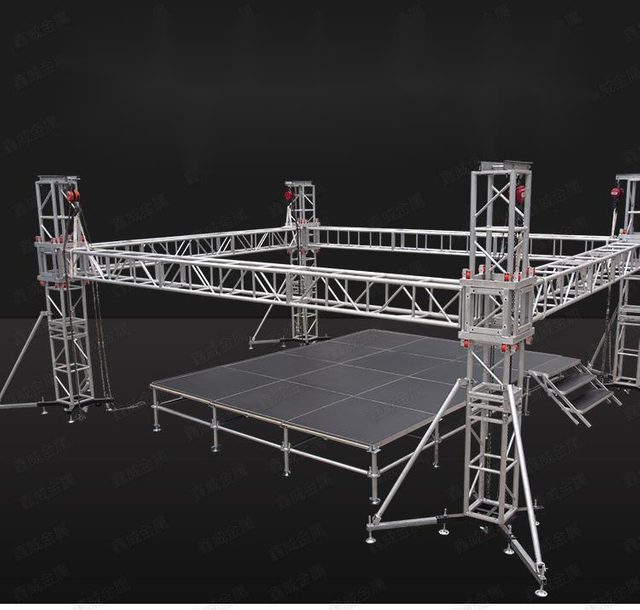
Temporary stage roofs
Ground support systems
Tower systems
Cross bracing is widely used in:
Event towers
Speaker towers
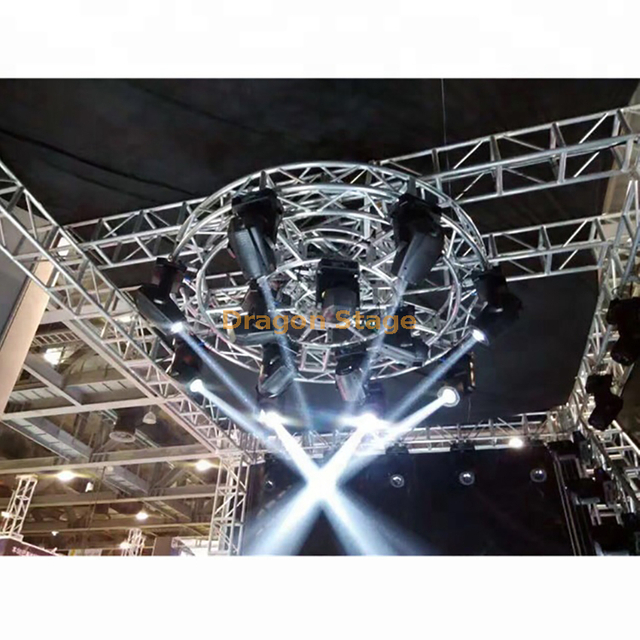
Lighting support systems
Under load:
4. Knee Braces
Function
Strengthens the connection between truss and support columns.
Benefits
Knee braces are common in:
Roof truss systems
Stage roof towers
Exhibition halls
5. Portal & Sway Bracing
Function
Maintains alignment between parallel trusses.
Common Use
Long-span roof systems
Bridge-like structures
Heavy-duty stage roofs
Portal bracing stabilizes the ends of the structure.
Sway bracing stabilizes the upper sections between trusses.
6. Outriggers & Stabilizer Braces
These are especially important in temporary event structures.
Function
Prevent overturning and improve base stability.
Common Applications
Ground support towers
Lighting towers
PA speaker towers
Outriggers increase the support footprint and reduce overturning risk.
This is critical for outdoor event systems.
Outdoor reference:
Outdoor Lighting Truss Guide (Rigging, Load & Safety for Events)
How Braces Improve Structural Stability
Braces improve stability in several ways.
Function | Stability Benefit |
|---|
Resist lateral load | Prevent side sway |
Create triangles | Prevent deformation |
Reduce buckling length | Improve compression stability |
Improve load distribution | Reduce stress concentration |
Increase rigidity | Improve structural safety |
Braces in Aluminum Stage Truss Systems
In aluminum event trusses, braces are visible as:
Diagonal tubes
Cross members
Stabilizer rods
Outriggers
Tower braces
They are especially important for:
Related reading:
What Is Lighting Truss? (Ultimate Guide for Stage, LED & Event Systems)
Common Misunderstandings About Truss Bracing
More Braces Always Mean Higher Capacity
Not necessarily.
Excessive bracing may:
Good engineering focuses on efficient bracing layout.
Braces Only Matter Outdoors
False.
Indoor systems also experience:
Dynamic movement
Rigging vibration
Unbalanced loading
Bracing is important in both indoor and outdoor structures.
Small Event Systems Do Not Need Bracing
Even small systems may become unstable without proper bracing.
Especially:
Tall towers
Narrow base systems
Hanging trusses
Relationship Between Main Chords, Web Members, and Braces
Component | Main Function |
|---|
Main Chord | Carry primary tension/compression |
Web Members | Transfer internal forces |
Braces | Stabilize the overall structure |
Related reading:
Why Bracing Is Even More Important in Temporary Structures
Temporary event systems face additional challenges:
This makes proper bracing critical.
Unlike permanent buildings, temporary structures rely heavily on modular bracing systems for safety.
Conclusion
A truss brace is a critical structural component used to stabilize truss systems and resist lateral forces such as wind, sway, and vibration. By creating rigid triangular geometry and improving load distribution, braces help prevent deformation, buckling, and structural failure.
In stage, lighting, roof, and event truss systems, proper bracing is essential for both safety and structural performance.