A truss web member is any diagonal or vertical member located between the top chord and bottom chord of a truss. Its primary function is to transfer loads between the chords, resist shear forces, and maintain the rigid triangular geometry that gives a truss its strength and stability.
Without web members, a truss would lose its structural integrity and could not efficiently support loads across long spans.
What Is a Web Member?
A typical truss consists of three primary components:
Component | Function |
|---|
Top Chord | Carries compression |
Bottom Chord | Carries tension |
Web Members | Transfer forces between chords |
The web members form the internal framework of the truss and are usually arranged as:
Simplified layout:
Top Chord
────────────────

 \   / \   /
  \ /   \ /
   X     X
  / \   / \

────────────────
Bottom Chord
These members create the triangular geometry that makes a truss structurally stable.
Why Are Web Members Important?
Load Transfer
When a truss carries lighting equipment, roofing systems, LED screens, or suspended loads, the forces generated in the chords must be transferred throughout the structure.
Web members provide this force path.
They transfer:
between the top and bottom chords.
Without web members, the load cannot be distributed effectively.
Structural Stability
The triangle is the simplest stable structural shape.
A rectangular frame can easily deform.
A triangular frame remains stable because its geometry is fixed.
Web members create these triangles throughout the truss.
This triangular arrangement prevents:
Side sway
Distortion
Structural collapse
and allows the truss to maintain its shape under load.
How Web Members Work in a Truss
When external loads act on the structure:
The exact force depends on:
Load position
Span length
Truss geometry
Support conditions
Structural principle:
External Load→Chord Forces+Web Member Forces\text{External Load} \rightarrow \text{Chord Forces} + \text{Web Member Forces}External Load→Chord Forces+Web Member Forces
Because web members primarily carry axial forces rather than bending forces, the structure uses material much more efficiently than a solid beam.
Common Types of Web Member Arrangements
The arrangement of web members defines the truss type.
Pratt Truss
Characteristics:
Diagonals slope toward the center
Diagonal members usually work in tension
Vertical members work in compression
Advantages:
Howe Truss
Characteristics:
Advantages:
Warren Truss
Characteristics:
Advantages:
Many modern stage trusses are based on Warren-style geometry.
K Truss
Characteristics:
Advantages:
Web Members in Aluminum Stage Trusses
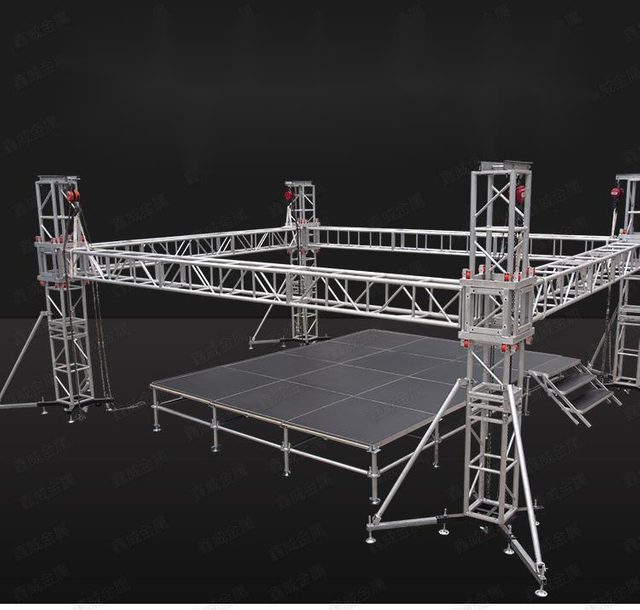
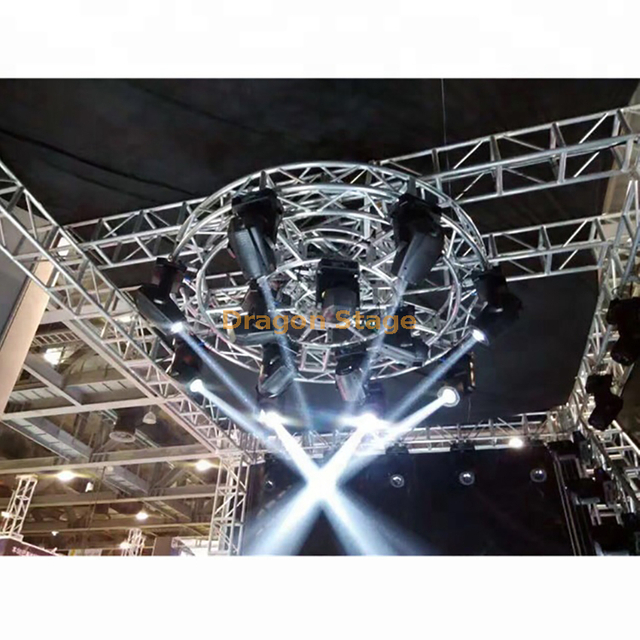
In event and entertainment structures, web members are the diagonal braces visible between the main tubes.
They:
Examples include:
Related reading:
What Is Lighting Truss? (Ultimate Guide for Stage, LED & Event Systems)
How Engineers Calculate Web Member Forces
Engineers typically use two classical methods.
Method of Joints
Each joint is isolated and analyzed using equilibrium equations.
Suitable for:
Method of Sections
An imaginary cut is passed through the truss.
Suitable for:
These methods help determine whether each web member is:
In tension
In compression
Within allowable limits
What Is a Zero-Force Member?
Not every web member carries force under every load condition.
Some members may carry:
F=0F=0F=0
under a particular loading case.
These are called zero-force members.
Although they may not carry force in one situation, they still serve important purposes:
Therefore, they should not be removed simply because calculations show zero force under one loading condition.
Main Chords vs Web Members
Feature | Main Chords | Web Members |
|---|
Carry Primary Load | Yes | Indirectly |
Transfer Shear Forces | No | Yes |
Create Structural Shape | Partial | Yes |
Control Span Capacity | Major Influence | Supporting Influence |
Structural Importance | Critical | Critical |
Main chords provide the primary load path.
Web members make the load path work.
Both are essential.
Related reading:
What Is a Truss Main Chord and Why Is It Important?
Common Misunderstandings
More Web Members Always Mean Higher Capacity
Not necessarily.
Truss strength depends on:
Main chord size
Material grade
Geometry
Connection quality
Adding web members alone does not automatically increase load capacity.
Web Members Only Provide Decoration
False.
Every web member contributes to load transfer and stability.
Removing a diagonal brace can significantly reduce structural performance.
Different web configurations behave differently under load.
Pratt, Howe, Warren, and K trusses each offer unique advantages depending on span, load type, and construction method.
Conclusion
Web members are the internal structural elements that connect the top and bottom chords of a truss. By transferring shear forces, distributing loads, and creating stable triangular geometry, they allow trusses to achieve high strength, long spans, and efficient material usage.
Whether in a bridge, roof system, stage truss, or lighting support structure, web members are essential components that make the entire truss system function safely and efficiently.