dragon stage
iron stage
You are here: Home / PRODUCT-HUB / staging / iron stage

Ringlock Steel Stage System with Fork Supported Deck and Beam Supported Deck


Answer Section

A ringlock steel stage system, also called iron stage, is a modular event stage built with steel vertical posts, horizontal ledgers, diagonal braces, adjustable bases, and stage decks.


In Dragon Stage products, this stage system can use two main deck support methods:

  • * Fork supported deck system
  • * Beam supported deck system, also known as Layher style deck support

Both systems are based on the same ringlock structure. The main difference is not the support frame itself, but how the stage deck is supported and connected on top of the steel ringlock base.

The stage deck normally uses 18mm plywood with an aluminum frame. The steel structure provides vertical support and bracing, while the deck system forms the walking and performance surface.


For full structural logic and component explanation, read:
Ringlock Stage System Explained – Structure, Components, Load Logic and Applications


What Is a Ringlock Steel Stage System?

A ringlock steel stage system is a temporary modular platform system based on scaffold-style ringlock components.

The main structure includes:

  • * steel vertical posts
  • * steel horizontal ledgers
  • * steel diagonal braces
  • * adjustable base jacks
  • * rosette / ringlock connection points
  • * stage deck panels
  • * stairs, guardrails, skirting, and accessories

This type of stage is commonly used for outdoor events, concerts, public activities, temporary performance platforms, and large event projects where higher structural strength and stable support are required.

Compared with lightweight aluminum modular stages, steel ringlock stages are heavier, but they provide strong support for large stage areas, high platforms, and demanding event environments.


For other stage system choices, you can also visit
stage platform
and
modular stage


Iron Stage

Iron Stage Key Features

  • Specifications

    the iron stage in the market mainly are 1.22x2.44m (4x8ft ) and 1.22x1.22m ( 4x4ft )

  • Height
    there are various heights are available to the iron stage 
    a. 0.6-1m; b. 1.6-2 m and higher
  • Load Capacity
    750kg/sqm
  • Material and main tube

    galvanized

    main tube: Diameter: 50X3mm

  • Charactoristics

    Heavy loading capacity and stable

    Demountable, easy to assemble and transport

    Self-locking, quick assemble

  • features of iron stage
    more about our stage
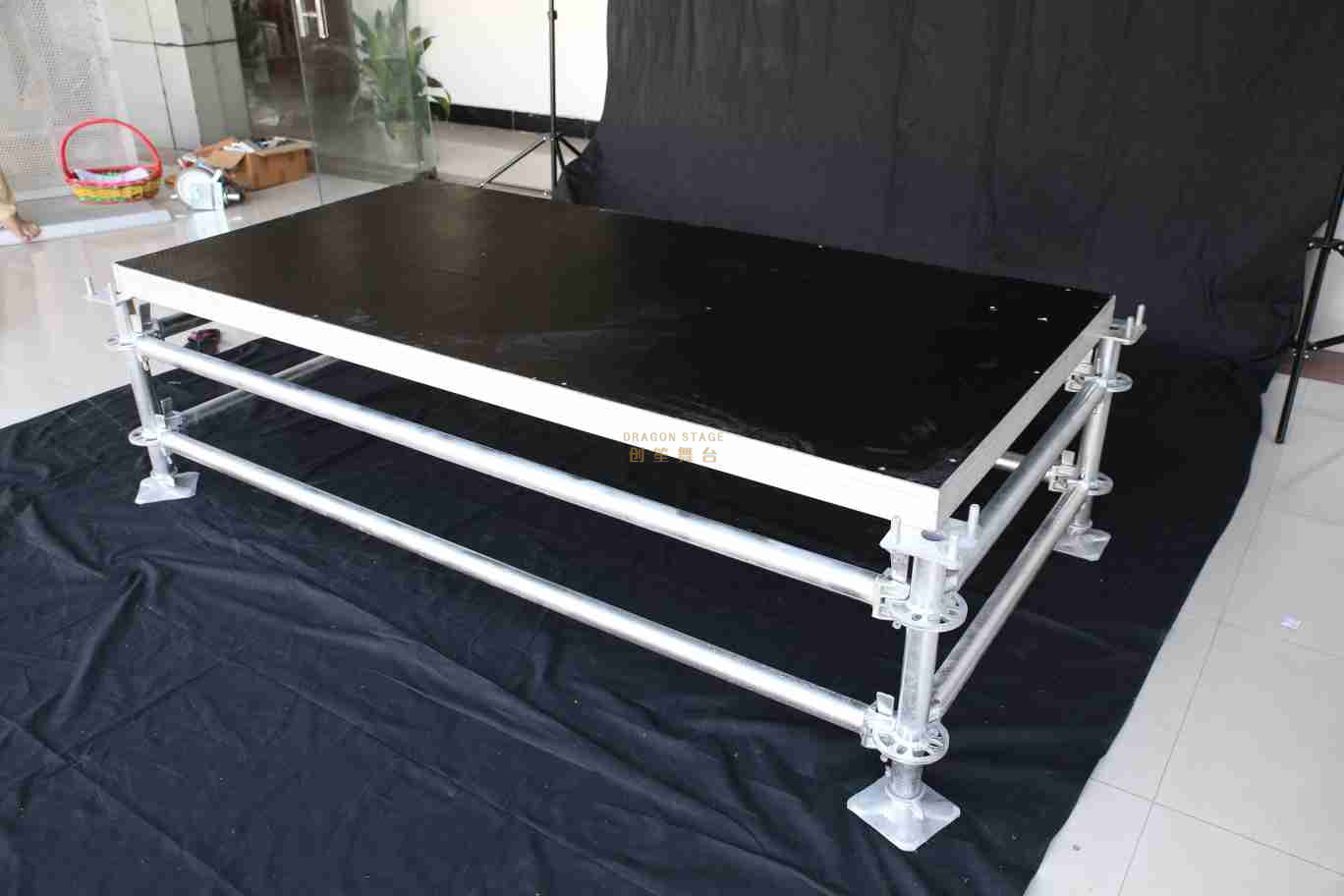
    the iron stage is also called the layer stage or steel stage, it is made of Hot zinc galvanization, it is disc locking connection design, it is also another kind of modular stage. it is easy to assemble and dismantle in a quick way.
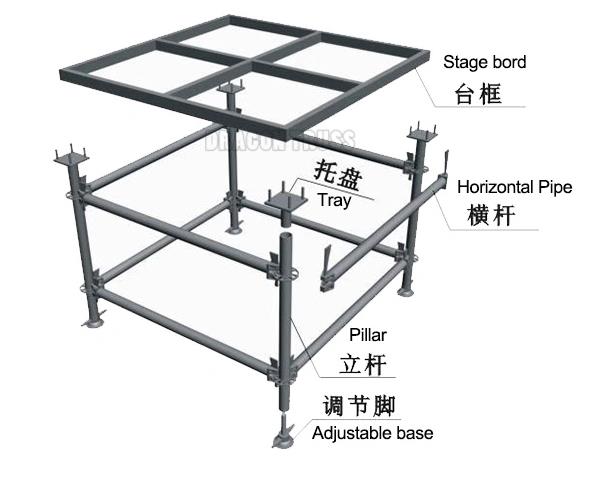
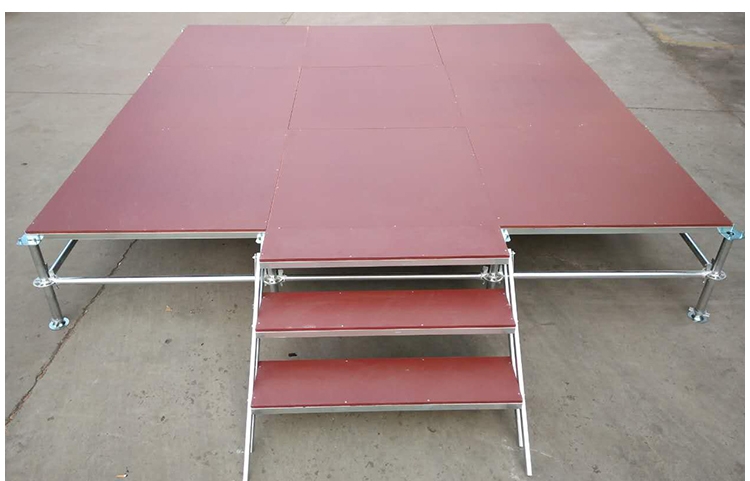
    it is heavier than the aluminium stage but has a larger loading capacity. the layer stage structure mainly includes stage topping ( stage deck/ stage platform/ stage board), stage leg pillar, connecting pipe and adjustable leg 4 parts, it can piece up to a sturdy and stable staging. its relevant parts include stage rails, stage stairs, and stage skirting. and normally, the stairs are flexible step stairs.
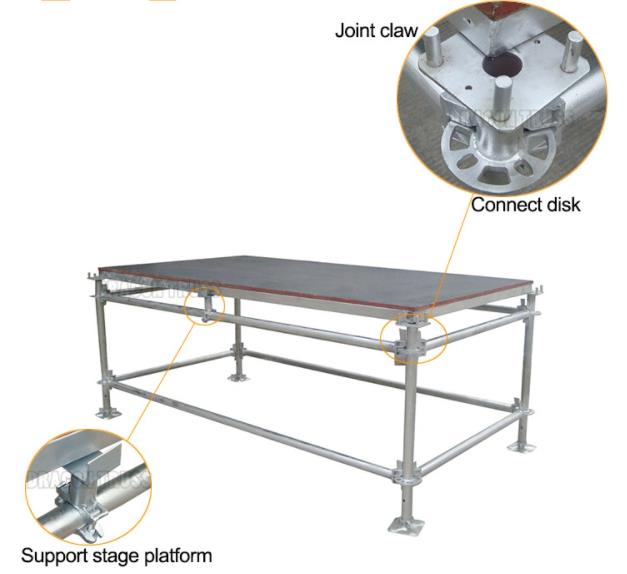
    the iron stage is built up as steel scaffolding staging. the deck is fixed on the pillar through the joint claw of the tray and connect disk.
    there is short support is designed at the middle of the horizontal pipe to hold the deck for stability.
    this stage is the heavy-duty stage, it is the most suitably used for large events and concerts, and hanging line array speaker and led screen.
  • stage structure
    stage deck board, stage leg pillar, connecting pipes, adjutable leg and tray
    steel iron stage
  • feature stage components
    pillar, diagonal/horizontal pipe, adjustable base, joint pipe, disk, clip lock, straight lock, oblique lock

    iron stage parts

  • stage topping material selection
    there are various topping materials to choose

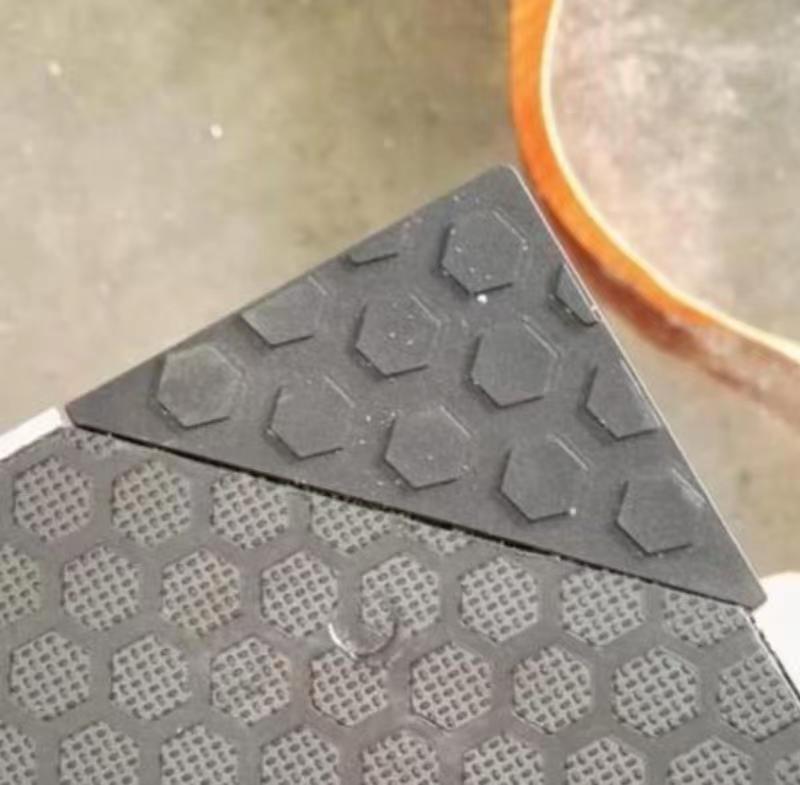
    Thickness:18mm
    1:plywood topping :red,black,brown colour 
    2:Acrylic glass topping: all kinds of color
    3:Tempered glass topping 
    4:Baboo plywood topping 

    layer stage

    layer stage deck choose

  • how to assemble pipe stage
    assembly steps
    layer stage structure
  • feature design
    joint claw and short support
     
    layer stage feature design
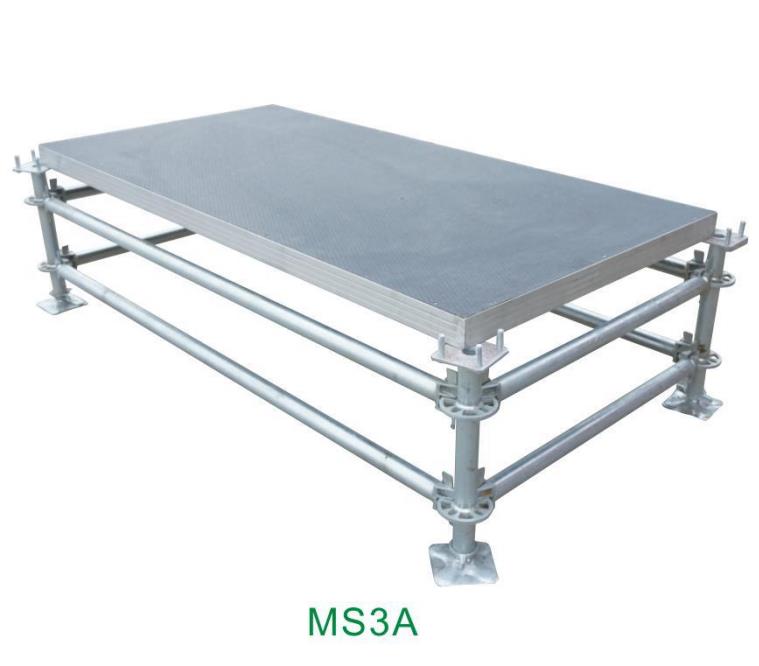
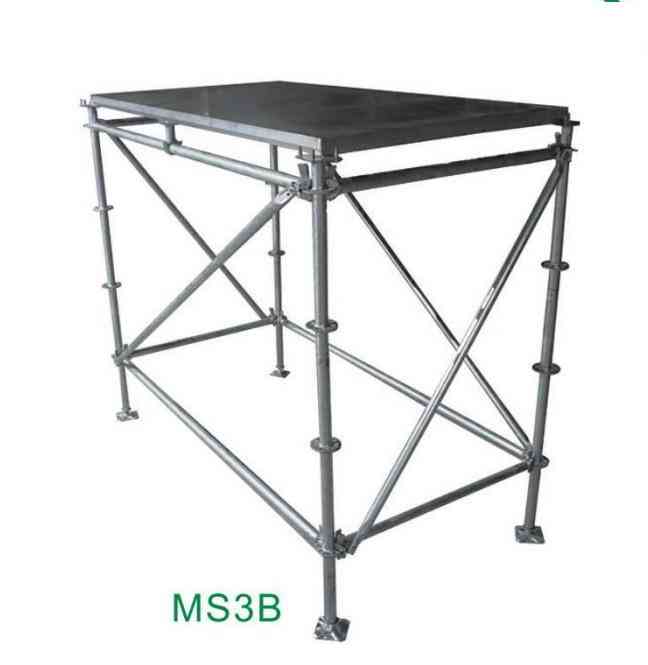
  • low iron stage and high iron stage
    differences between low iron stage and high iron stage
    MS3AMS3B
  • custom deck and fittings for those guardrails
    this fittings can be removed to put the vertical pillar in the bottom pipe
  • diagram for pillar in the middle of 4 decks
    1 pillar installed in custom 4 decks adjacent

Two Deck Support Methods in Ringlock Steel Stage

The ringlock base structure can be similar, but the deck support method can be different.

Dragon Stage mainly provides two deck support structures:

  • * Fork Supported Deck
  • * Beam Supported Deck

This is the most important point of this page.

It is not a simple “steel stage vs Layher stage” comparison. Both belong to the ringlock stage family. The difference is the connection and support method between the deck panel and the steel ringlock structure.


Fork Supported Deck System


In a fork supported deck system, the stage deck is supported directly by fork-shaped steel supports connected to the vertical posts.

The fork works as the receiving point for the deck panel. The deck is placed on the fork support, and the load is transferred from the deck to the vertical posts.

This system usually includes:

  • * steel ringlock vertical posts
  • * steel horizontal ledgers
  • * steel diagonal braces
  • * fork support heads
  • * 18mm plywood deck with aluminum frame
  • * panel-to-panel locking or screw fixing when required

This structure is practical for temporary stage projects because it is simple, direct, and efficient.


Main Features of Fork Supported Deck


  • * direct deck support on the post position
  • * faster installation
  • * fewer support components
  • * lower system complexity
  • * suitable for temporary event stages
  • * cost-effective for medium-duty projects

The important point is that the fork supported system depends more on correct deck placement, post alignment, bracing, and panel locking. When the decks are fixed together by screws or locking connections between panels, the platform surface becomes more integrated and stable.


Suitable Applications


Fork supported ringlock stage is suitable for:

  • * outdoor temporary events
  • * wedding stages
  • * exhibition platforms
  • * public activity stages
  • * medium-size concert stages

  • projects where fast installation and cost control are important


Beam Supported Deck System


In a beam supported deck system, aluminum beams are installed between the ringlock posts. The stage deck is then placed on the aluminum beam support structure.

This is often called a Layher style stage deck support method in the event industry.

The beam creates a more continuous support line under the deck, instead of supporting the deck mainly at fork points.

This system usually includes:

  • * steel ringlock vertical posts
  • * steel horizontal ledgers
  • * steel diagonal braces
  • * aluminum support beams
  • * beam connectors or end inserts
  • * 18mm plywood deck with aluminum frame
  • * deck locking or beam slot fixing

Your existing page already includes steel and aluminum fixing parts for Layher-style deck support, including a beam used to hold and fix Layher stage decks with end inserts, and an aluminum fixing beam with a long slot where adjacent deck frames can share one slot to help keep the stage surface straight and firm.


Main Features of Beam Supported Deck

  • * deck load is distributed through support beams
  • * better platform flatness
  • * stronger deck alignment
  • * more integrated stage surface
  • * better rigidity for repeated use
  • * suitable for professional event projects

The beam supported system normally has more components than the fork supported system, but it provides better deck support continuity and stronger structural integration.


Suitable Applications


Beam supported ringlock stage is suitable for:

  • * concert stages
  • * large outdoor platforms
  • * professional event stages
  • * LED screen and line array support areas
  • * higher requirement temporary structures
  • * repeated rental use


Fork Supported Deck and Beam Supported Deck: Structural Difference


Item


Fork Supported Deck


Beam Supported Deck
Base structureRinglock steel structureRinglock steel structure
Deck supportFork head supports deck directlyAluminum beam supports deck
Load transferDeck → fork → vertical postDeck → beam → vertical post
Installation speedFasterModerate
Component quantityFewerMore
Surface integrationDepends more on deck lockingBetter deck alignment
Cost levelLowerHigher
Best useTemporary and cost-sensitive eventsProfessional and heavier-duty stages


This table is not meant to say one system is always better than the other. It helps buyers understand how the same ringlock stage system can be configured for different project requirements.


Stage Deck Structure


Both systems normally use stage decks made with:

  • * 18mm anti-slip plywood
  • * aluminum frame around the panel
  • * reinforced deck structure
  • * optional surface color or material finish

The plywood provides the walking surface. The aluminum frame improves edge strength, panel durability, and connection accuracy.

In the fork supported system, the deck is directly supported by fork heads.

In the beam supported system, the deck is supported by aluminum beams, which improves support continuity and deck alignment.

For more information about stage deck selection, read How to Choose Stage Platform for Events and Stage Platform Material Comparison.



New Design Steel Fixing Parts for Layher Stage


Steel Fixing Parts for Layher Stage
       Steel Beam
this new design steel beam is used to hold and fix the layher stage deck with end-inserts
  Univeral Connector
the steel beam has universal connector to the layher truss fixing disk
Steel Fixing Parts for Layher Stage
Custom Sizes to Deck Dimensions
layher stage deck can be 1.22x1.22m, 1.22x2.44m or 1x2m; the steel beam also can be custom to produce as the deck dimensions.
Steel Fixing Parts for Layher Stage


New Design Aluminum Fixing Parts for Layher Stage


aluminum Fixing Parts for Layher Stage
Aluminum Fixing Parts for Layher Stage
Similar to steel fixing parts for layher stage, aluminum fixing beam (3mm thick) has a long slot for the stage deck to put in, and two adjacent deck frame share one slot to keep the whole stage straight and firm. At both ends, the beam has inserts to connect to layher truss disk.


TUV Tests on New Aluminum Layher Stage

We have called TUV test company to give our new aluminum layer stage loading capacity.
New Aluminum Layher Stage before test
New Aluminum Layher Stage in testing

TUV SUD Certification and Testing (China) Co., Ltd. Guangzhou Branch carried the tests based on "general terms and conditions".

1. Description of test subject:

product name: aluminum quick stage

2. Dimensions:

overall dimensions 2m L x 2m W

unit deck dimensions 2m L x 1m W

frame & transom  aluminum alloy & steel layher truss

panel laminated plywood T18.0 T93.0 NON slip

side aluminum transom 140mm H

leg profile Dia.48 x T3.0

During the test,the specified loads were applied and deformations were measured 5 minutes after load and 5 minutes after load removal.

3. Uniformly distributed load (UDL)
The stage was supported by four poles at four ends.A specified nominal load was uniformly distributed according to Figure1. on the stage and the deflection under this loading condition was measured accordingly.

4. Test information

Surface Area, (m2) 2

UDL, (kg/ m2) 900

Total load applied, (kg) 1800

Measured deflection, (mm) 21

Residual deflection, (mm) 0

5. Test result

No visible damage was found during and after test.


Why Use Steel Ringlock Structure for Stage Platforms?


Steel ringlock stage is used because it provides strong vertical support and flexible modular expansion.

It is suitable when the project needs:

  • * larger stage area
  • * stronger support structure
  • * adjustable height
  • * outdoor stability
  • * modular layout

For detailed engineering calculation, load path and safety factors, read:
Ringlock Stage Load Calculation – Load Path, Deck Support and Safety Factors

You can also refer to the general structural analysis page:
Load Analysis for Modular Stage Systems


When to Choose Fork Supported Deck


Choose fork supported deck when the project needs:

  • * faster installation
  • * simpler structure
  • * lower cost
  • * medium-duty temporary stage
  • * flexible event use
  • * easier transportation and assembly

This structure is practical for rental companies and temporary events where the stage does not require the highest deck integration or the most rigid beam-supported surface.


When to Choose Beam Supported Deck


Choose beam supported deck when the project needs:

  • * better stage surface flatness
  • * stronger deck alignment
  • * higher platform rigidity
  • * better load distribution
  • * professional concert or event use
  • * repeated installation and dismantling

This structure is more suitable for projects where the stage needs to feel more solid, more integrated, and more professional during use.


Product Selection Guide


Project Requirement

Recommended Structure
Fast setup and lower costFork supported deck
Better deck flatnessBeam supported deck
Medium temporary event stageFork supported deck
Professional concert stageBeam supported deck
Repeated rental useBeam supported deck
Simple outdoor platformFork supported deck
Higher stability requirementBeam supported deck
Large platform with access stairs and guardrailsBeam supported deck or engineered ringlock
 layout


Typical Applications
layher truss for concerts and events

Concerts and Outdoor Events

Ringlock steel stage systems are widely used for concerts and outdoor events because the steel structure provides strong support and modular expansion. For large events, beam supported deck systems are often preferred for better platform integrity.
ringlock stage for wedding and ceremony

Wedding and Ceremony Stages

Fork supported deck systems can be used for wedding stages and temporary ceremony platforms where fast installation and cost control are important.
layher truss for exhibition and brand events

Exhibition and Brand Events

For exhibitions, both fork supported and beam supported ringlock stages can be used depending on stage height, load requirement, and visual design.
layher temporary sturcture

Temporary Access and Structural Platforms

Because ringlock structure is also widely used in scaffold-style systems, steel ringlock stages can be adapted for temporary access platforms and structural support applications.

Engineering Notes for Safe Use


When designing a ringlock steel stage, the following points should be confirmed:

  • * stage length and width
  • * stage height
  • * deck type and deck size
  • * live load requirement
  • * bracing layout
  • * ground condition
  • * adjustable base height
  • * stairs and guardrail position
  • * deck locking method
  • * wind and outdoor conditions


The support method should be selected according to the real project condition, not only by price.

For technical reference, you can read Installation Methodology for Modular Stage, Truss & Scaffold Systems and Common Stage Safety Issues and How to Avoid Them.


Related Products and Systems


FAQ


Is iron stage the same as ringlock stage?

In many event industry applications, iron stage or steel stage refers to a stage system built with steel ringlock components. It uses vertical posts, horizontal ledgers, diagonal braces, adjustable bases, and stage decks to form a modular platform.


Are fork supported deck and beam supported deck different stage systems?

They are different deck support methods within the ringlock stage system. The base structure can still be steel ringlock. The difference is how the deck is supported: directly by fork heads or by aluminum support beams.


Is beam supported deck always better than fork supported deck?

Not always. Beam supported deck usually gives better alignment and rigidity, but fork supported deck is faster, simpler, and more cost-effective for many temporary events.


What is the deck material of a steel ringlock stage?

The stage deck commonly uses 18mm anti-slip plywood with an aluminum frame. This design balances strength, durability, and practical handling.


Which system should I choose for a concert stage?

For larger concert stages, beam supported deck is usually more suitable because it provides better deck alignment and stronger platform integration. For smaller or temporary event stages, fork supported deck can also be practical.


Can the stage size and height be customized?

Yes. Ringlock steel stage systems can be customized by stage length, width, height, deck type, stair position, guardrail layout, and project requirements.


How to Get a Custom Quick Stage


If you need a ringlock steel stage system for an event, concert, exhibition, or temporary platform, send us your stage size, required height, loading requirement, deck type, and project location. Dragon Stage can help you choose between fork supported deck and beam supported deck structures and provide a practical stage solution for your project.

FOSHAN DRAGON STAGE 

No.7,Xiaxi Industrial Area,Heshun,Nanhai District,Foshan,528241,Guangdong,China.

 +86  136 3132 8997

QUICK LINKS

PRODUCT LIST

Copyright © 2020 FOSHAN DRAGON STAGE EQUIPMENT CO.,LTD  备案号:粤ICP备2020113505号